

[Aug-2023] 4A0-AI1 Exam Dumps, 4A0-AI1 Practice Test Questions
Attested 4A0-AI1 Dumps PDF Resource [2023]
To take the Nokia 4A0-AI1 exam, candidates must have a strong background in IP networking and automation. They should have experience in designing, configuring, and managing large-scale networks, as well as a good understanding of automation tools and technologies. 4A0-AI1 exam is designed to test the candidate's knowledge of automation techniques, including programming languages used in automation, network automation tools and platforms, and best practices for network automation and management.
NEW QUESTION # 17
Which of the following configures the network based on input provided by the user?
- A. Framework files
- B. YANG module
- C. Intent Type
- D. Intent
Answer: D
Explanation:
Explanation
Intent is a high-level description of the desired outcome or state of the network. It allows users to specify what they want to achieve rather than how to achieve it. The intent is then translated into network configurations and policies that are used to configure the network infrastructure. Intent-based networking provides a higher level of abstraction than traditional network configuration methods, making it easier for users to specify their requirements and automate the configuration process.
NEW QUESTION # 18
Which of the following statements about the YANG data modeling language is FALSE?
- A. Data is in the form of a tree-like structure.
- B. Defines actions and operations.
- C. Data model is not human readable.
- D. It is used to model configuration and state data.
Answer: C
Explanation:
Explanation
YANG is a data modeling language used to model configuration and state data for network devices. It defines a tree-like structure for data and is used to store, configure, and retrieve information from network devices. It is human readable and can be used to define actions and operations.
NEW QUESTION # 19
Which of the following is NOT a common workflow attribute defined by Mistral?
- A. Type
- B. Output
- C. Input
- D. Workflow-meta
Answer: D
Explanation:
Explanation
According to the Mistral Workflow Language (v2) website1, a workflow definition consists of several attributes that define its properties and behavior. The common workflow attributes are: name, description, type, input, output and vars1.
NEW QUESTION # 20
Which of the following protocols or standards is NOT used in Model Driven Telemetry?
- A. NETCONF
- B. KAFKA
- C. gRPC
- D. CLI
Answer: D
Explanation:
Explanation
CLI is not used in Model Driven Telemetry. Model Driven Telemetry is a technology that uses YANG data models, NETCONF, gRPC and KAFKA to monitor and collect data from network elements. It provides an abstracted view of the network element and is vendor agnostic.
Model Driven Telemetry is a method of collecting real-time data from network devices, allowing for more efficient network monitoring and troubleshooting. It uses a variety of protocols and standards, including NETCONF, gRPC, and Kafka. However, CLI is a text-based user interface used for issuing commands to a device, and it is not typically used for collecting telemetry data.
According to the Nokia Network Services Platform for industry and the public sector datasheet1, NSP model-driven telemetry framework supports the Nokia SR OS and third-party devices in configuring and collecting performance statistics using gRPC, SNMP, NETCONF and accounting files such as SAP QoS1. It also enables data to be persisted in a database and be made available (e.g., over a Kafka bus) for a variety of use cases1.
NEW QUESTION # 21
Match the following description with its meaning.
X - "uses Playbooks, written in simple YAML, that defines server configuration." Y - "workflow service that aims to provide a way to define, manage, and execute tasks and workflows in the cloud without writing code.'' Z - "a detailed specification for the desired network configuration.'' W - "an application that allows the creation of complex operational workflows using an intuitive GUI.''
- A. X - NSP Workflow Manager (WFM)
Y - Openstack Mistral
Z - Intent type
W - Ansible - B. X - Ansibie
Y - Openstack Mistral
Z - Intent type
W - NSP Workflow Manager (WFM) - C. X - Openstack Mistral
Y - Ansible
Z - Intent type
W - NSP Workflow Manager (WFM) - D. X - Ansible
Y - Openstack Mistral
Z - NSP Workflow Manager (WFM)
W - Intent type
Answer: A
NEW QUESTION # 22
Which of the following is the master configuration that is synchronized with the network configuration and is stored in the database as the source of truth?
- A. Metadata
- B. YANG module
- C. Intent Type
- D. Intent
Answer: D
Explanation:
Explanation
An Intent is the master configuration that is synchronized with the network configuration and is stored in the database as the source of truth. Intent Types define the type of Intent, such as a network service or a configuration change, while Metadata is used to store additional information about the Intent, such as its version or author. YANG modules are used to define the data model for a particular technology.
NEW QUESTION # 23
Which of the following statements about the NSP Workflow Manager is FALSE?
- A. It supports parallel execution of many workflow.
- B. It supports scheduling of workflow executions.
- C. It provides several building tools to design and create new workflows.
- D. It uses Openstack Heat as the core workflow engine.
Answer: D
Explanation:
Explanation
According to the Nokia NSP Workflow Manager Application Help , Workflow Manager has the following characteristics:
* It provides several building tools to design and create new workflows. You can use graphical editors, text editors, or import existing workflows from files or repositories.
* It uses Openstack Mistral as the core workflow engine. Mistral is an open source project that provides a service for managing workflows across multiple cloud platforms.
* It supports scheduling of workflow executions. You can use cron expressions or triggers to specify when and how often a workflow should run.
* It supports parallel execution of many workflows. You can run multiple workflows simultaneously on different network elements or services.
Therefore, based on these sources, the correct answer is:
It uses Openstack Heat as the core workflow engine.
This is FALSE because Workflow Manager uses Openstack Mistral, not Heat, as the core workflow engine.
Heat is another open source project that provides a service for orchestrating multiple cloud applications using templates.
The other statements are TRUE because:
* It provides several building tools to design and create new workflows. This allows you to create workflows that suit your specific network needs and preferences.
* It supports scheduling of workflow executions. This allows you to automate recurring network tasks and optimize network performance and availability.
* It supports parallel execution of many workflows. This allows you to handle complex network scenarios and operations efficiently and effectively.
NEW QUESTION # 24
Which of the following is NOT a characteristic of Infrastructurelure Intents?
- A. Initial hardware configuration
- B. L2/L3 VPN configuration of multiple services
- C. Policy management
- D. System security
Answer: B
Explanation:
Explanation
Infrastructure Lure Intents are a type of Network Intent that describe how network resources should be allocated and configured for a specific service or application.
L2/L3 VPN configuration of multiple services is NOT a characteristic of Infrastructure Lure Intents, because it is more related to service provisioning than resource allocation.
NEW QUESTION # 25
Which input is optional when using the std.ssh action to access a remote server?
- A. username
- B. host
- C. password
- D. cmd
Answer: D
Explanation:
Explanation
the input that is optional when using the std.ssh action is cmd. This parameter specifies the command to be executed on the remote server1. If this parameter is not provided, the action will only establish an SSH connection with the remote server and return its output1. The other parameters are required to authenticate and connect to the remote server.
NEW QUESTION # 26
Which of the following is NOT an example of good coding principles?
- A. Offloading code
- B. Using logging to debug code
- C. Using hard coded values
- D. Adding notes/comments into code
Answer: C
Explanation:
Explanation
Good coding principles aim to make the code more maintainable and easier to debug. Offloading code and using logging to debug code are both good coding principles, as they make the code more efficient and easier to debug. Adding notes and comments into code is also a good coding practice, as it makes the code more readable and understandable. However, using hard coded values is not a good coding practice, as it makes the code more difficult to maintain and debug.
NEW QUESTION # 27
Which of the following statements about the NSP Workflow Manager (WFM) application is FALSE?
- A. Only one workflow can be executed at one time.
- B. It allows network management tasks to be automated.
- C. Actions and expressions are extensible using Python.
- D. A workflow action can run against RESTCONF APIs.
Answer: A
Explanation:
Explanation
The NSP Workflow Manager (WFM) application allows network management tasks to be automated by creating workflows. Multiple workflows can be run in parallel, and actions and expressions are extensible using Python. Additionally, a workflow action can run against RESTCONF APIs.
According to the NSP Release 19.11 Workflow Manager Application Help , Workflow Manager (WFM) is an application that allows network management tasks to be automated using Nokia NSP or third-party APIs1
. WFM supports a variety of use cases such as node software upgrades, service activation tests, service fulfillment and mass migration of services . WFM uses actions and expressions that are extensible using Python1. A workflow action can run against RESTCONF APIs as well as other protocols such as SNMP, NETCONF and CLI1.
NEW QUESTION # 28
What task does Apache FreeMarker perform?
- A. Separates the configuration and data states
- B. Allows communication between NSP applications
- C. It instantiates templates.
- D. Transports YANG data
Answer: C
Explanation:
Explanation
Apache FreeMarker is a templating language used to create dynamic webpages. It is designed to separate the configuration and data states, allowing the template to have a consistent look and feel across all webpages.
FreeMarker allows the template to instantiate the data, allowing the template to be reused in different contexts.
It does not allow communication between NSP applications or transport YANG data.
NEW QUESTION # 29
Which of the following sequences best describes the process of moving to SDN based self-regulated networking?
- A. action-based networking -> static networking -> adaptive networking -> autonomous networking
- B. static networking -> action-based networking -> autonomous networking -> adaptive networking
- C. action-based networking -> static networking -> autonomous networking -> adaptive networking
- D. static networking -> action-based networking -> adaptive networking > autonomous networking
Answer: D
Explanation:
Explanation
Nokia NSP is a platform that enables management, control and automation of IP/Optical networks. It supports various levels of network automation, from static networking to autonomous networking.
The process of moving to SDN based self-regulated networking involves four stages:
* Static networking: The network is manually configured and operated by human operators. There is no automation or intelligence involved.
* Action-based networking: The network is partially automated by using predefined actions or scripts that are triggered by events or commands. There is still human intervention required for complex tasks or exceptions.
* Adaptive networking: The network is dynamically automated by using policies, analytics and machine learning that can adjust the network behavior based on changing conditions and objectives. There is minimal human intervention required for oversight and validation.
* Autonomous networking: The network is fully automated by using artificial intelligence and closed-loop feedback that can optimize the network performance and reliability without any human involvement.
The network can self-heal, self-optimize and self-protect.
NEW QUESTION # 30
Which of the following scripting languages can be used to extend WFM actions and expressions?
- A. Perl
- B. Groovy
- C. PHP
- D. Python
Answer: B
Explanation:
Explanation
According to the Nokia NSP Programmable Network Automation website , NSP API documentation and downloadable sample codes are available on the Nokia Network Developer Portal. The NSP Workflow Manager allows the design and management of workflows to automate network operations using Mistral DSL v2 which is based on YAML2. YAML definesexpressions in workflow and action definitions. The formatting of the YAML must comply with Mistral DSL v2 specifications3
NEW QUESTION # 31
Which of the following statements about Kafka is FALSE?
- A. It is an open-source platform.
- B. It has four components: Producer, Consumer, Topic and Connector.
- C. It is a distributed messaging system.
- D. It is used to send real-time notifications.
Answer: B
Explanation:
Explanation
Kafka is a distributed messaging system that is open-source and can be used to send real-time notifications.
However, it has more than four components, such as brokers, partitions, replicas, consumer groups and zookeeper.
NEW QUESTION # 32
Which Workflow state allows a Workflow to be executed?
- A. Published
- B. Released
- C. Deprecated
- D. Draft
Answer: A
Explanation:
Explanation
According to the Workflow Manager User Guide from Nokia, the correct answer is C. Published. When a workflow is in the Published state, it can be executed by users who have the appropriate permissions. The Draft state is used during the creation of a new workflow, while the Deprecated state indicates that a workflow is no longer supported and should not be used. The Released state is not mentioned in the context of workflow execution.
NEW QUESTION # 33
When using the nsp.netconf action, what does the host input represent?
- A. Management IP address
- B. L3 base router interface
- C. System IP address
- D. NSP server address
Answer: A
Explanation:
Explanation
nsp.netconf is a nodal communication action that uses NETCONF protocol to communicate with network devices. The host input represents the management IP address of the device that is being configured by NSP. It is one of the inputs required for nsp.netconf along with username, password, port and command.
NEW QUESTION # 34
Based on the exhibit, which of the following is the proper syntax to publish ONLY information about the RTT to the workflow context?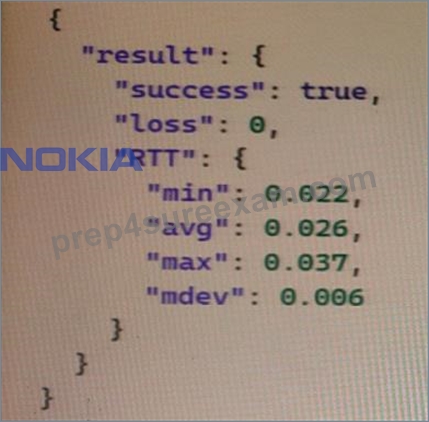
A)
B)
C)
D)
- A. Option D
- B. Option C
- C. Option A
- D. Option B
Answer: B
Explanation:
Explanation
This syntax assumes that there is a previous task that returns an object with an attribute named rtt that contains the round-trip time value1. The expression <% task().result.rtt %> evaluates to this value and assigns it to the variable rtt in the workflow context
NEW QUESTION # 35
Which of the following is NOT a characteristic of Intent-based networking?
- A. Virtualization
- B. Abstraction
- C. Persistence
- D. Automation
Answer: A
Explanation:
Explanation
Virtualization is not a characteristic of intent-based networking, but rather a technology that enables it. Virtualization is the process of creating virtual versions of physical resources, such as servers, storage, or networks1. Virtualization allows for more flexibility and scalability in network design and management, but does not imply any automation or intelligence.
NEW QUESTION # 36
......
Nokia 4A0-AI1 exam is a professional level certification exam that tests your skills and knowledge in the field of IP network automation. 4A0-AI1 exam is designed to evaluate your understanding of the Nokia Service Router Operating System (SROS) and the implementation of automation techniques to manage and monitor network infrastructure.
Nokia 4A0-AI1 certification exam is ideal for professionals who are looking to enhance their career in network automation and management. Nokia NSP IP Network Automation Professional Composite Exam certification is recognized globally, and it is highly valued by employers in the telecommunications industry. 4A0-AI1 exam is also suitable for individuals who are looking to acquire new skills and knowledge in network automation using NSP. Nokia NSP IP Network Automation Professional Composite Exam certification exam is designed to validate the candidate’s proficiency in the use of NSP for network automation, making them highly valuable in the job market.
Latest 4A0-AI1 Actual Free Exam Questions Updated 82 Questions: https://www.prep4sureexam.com/4A0-AI1-dumps-torrent.html
Free 4A0-AI1 Exam Braindumps certification guide Q&A: https://drive.google.com/open?id=1rKuvZg0Xu0ZNrGwYb2Dm7hBaaj9wfsBY