

[Dec-2023 Newly Released] B2B-Commerce-Developer Dumps for Salesforce Developer Certified
Updated Verified B2B-Commerce-Developer dumps Q&As - 100% Pass
To become a Salesforce Accredited B2B Commerce Developer, candidates must pass the B2B-Commerce-Developer exam, which consists of 60 multiple-choice questions to be completed within 105 minutes. B2B-Commerce-Developer exam is intended for individuals who have experience with the Salesforce B2B Commerce platform and are familiar with the development tools and best practices. Successful completion of the exam shows that the candidate is well-versed in the latest techniques and practices in Salesforce B2B Commerce development, and is capable of designing and implementing solutions that meet the unique needs of B2B businesses.
Salesforce B2B-Commerce-Developer Exam is a must-have certification for developers who are interested in pursuing a career in Salesforce B2B Commerce development. It is a challenging exam that requires practical experience and dedication to pass. However, passing B2B-Commerce-Developer exam can open up a world of opportunities for you in the Salesforce ecosystem.
NEW QUESTION # 38
What two kinds of queries do the methods in Salesforce B2B Commerce services perform by default? (2 answers)
- A. SQL
- B. SOSL
- C. Schema-less queries
- D. SOQL
Answer: C,D
Explanation:
Two kinds of queries that the methods in Salesforce B2B Commerce services perform by default are SOQL and schema-less queries. SOQL is the query language that is used to retrieve data from Salesforce objects and fields. Schema-less queries are queries that do not specify the object or field names explicitly, but use placeholders instead. For example, ccrz.ccServiceDao.getQuery('SELECT Id FROM Account WHERE Name = :name') is a schema-less query that uses :name as a placeholder for the field name. The framework will transform this query to use the actual field name based on the query transformation rules. Salesforce Reference: B2B Commerce and D2C Commerce Developer Guide, Query Transformation
NEW QUESTION # 39
What are two considerations to keep in mind when including additional JavaScript files in a Lightning web component?
- A. Each additional file needs a corresponding .js-meta.xml file.
- B. Additional JavaScript files should be minified before deployment
- C. The files must be ES6 modules and must have names that are unique within the component's folder.
- D. A module can export named functions or variables
Answer: C,D
Explanation:
Explanation
When including additional JavaScript files in a Lightning web component, a developer should keep in mind two considerations: the files must be ES6 modules and must have names that are unique within the component's folder and a module can export named functions or variables. The files must be ES6 modules because LWC uses ES6 modules as the standard for modular JavaScript code. The files must have names that are unique within the component's folder because LWC uses the file name as the module identifier and does not allow duplicate identifiers. A module can export named functions or variables because LWC supports named exports, which allow a module to export multiple values with different names. Each additional file does not need a corresponding .js-meta.xml file, as this is only required for the main JavaScript file of the component. Additional JavaScript files should not be minified before deployment, as this is not necessary or recommended for LWC. Salesforce References: [Lightning Web Components Developer Guide: Include JavaScript Files], [Lightning Web Components Developer Guide: ES6 Modules]
NEW QUESTION # 40
Which cookie stores the effective account ID when effective account is enabled?
- A. apex__currCartId
- B. apex__effacc
- C. apex__cc_anonymous_Country
- D. apex__cclgtkn
Answer: B
NEW QUESTION # 41
Which cart item type is created with the Cart Delivery Group Method after the shipping integration?
- A. Delivery
- B. Shipping
- C. Surcharge
- D. Charge
Answer: D
Explanation:
A cart item with a type of Charge is created with the Cart Delivery Group Method after the shipping integration. A shipping integration is an integration that calculates and applies shipping costs and options to a cart or an order based on various factors, such as product weight, dimensions, quantity, location, and carrier service level. A shipping integration can use either an external shipping service provider or custom Apex code to perform the shipping calculation. The Cart Delivery Group Method is a method that determines how products are grouped into delivery groups based on their shipping methods and addresses. A delivery group is a logical grouping of products that are shipped together using the same shipping method and address. After performing the shipping calculation for each delivery group, the shipping integration creates a cart item with a type of Charge and a charge type of Shipping for each delivery group. These cart items represent the shipping costs and options that are applied to each delivery group. A cart item with a type of Surcharge, Shipping, or Delivery does not exist or is not related to the shipping integration. Salesforce Reference: [B2B Commerce Developer Guide: Shipping Integration], [B2B Commerce Developer Guide: Cart Delivery Group Method]
NEW QUESTION # 42
Which format is the custom Salesforce relationship with the API name,
"My_Relationship_Name__r.My_Name__c" queried and transformed into dy default in Salesforce B2B Commerce?
- A. My_Relationship_Name__r.My_Name__c: value
- B. myrelationshipname.myname: value
- C. myRelationshipName.myName: value
- D. myRelationshipNameR=>(myName: value)
Answer: D
Explanation:
Explanation
The format that the custom Salesforce relationship with the API name,
My_Relationship_Name__r.My_Name__c is queried and transformed into by default in Salesforce B2B Commerce is myRelationshipName.myName: value. This is done to follow the JavaScript naming convention and to avoid conflicts with the standard Salesforce fields and relationships. The transformation rules are as follows:
* Remove any namespace prefix from the field name, such as ccrz__ or cloudcraze__.
* Remove any underscores from the field name and capitalize the first letter of each word after an underscore, such as MyRelationshipName and MyName.
* Lowercase the first letter of the field name, such as myRelationshipName and myName.
* Use a dot (.) to separate the relationship name and the field name, such as myRelationshipName.myName.
* Use a colon (:) to separate the field name and the field value, such as myRelationshipName.myName:
value. Salesforce References: B2B Commerce and D2C Commerce Developer Guide, Query Transformation
NEW QUESTION # 43
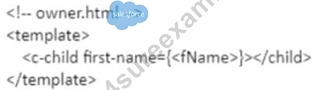
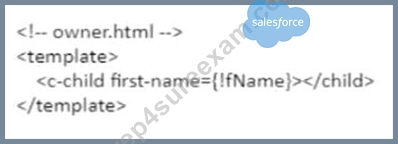
Northern Tail Outfitters (NTO) is converting an existing aura component into a Lightning Web Component.
The aura component has the following source code:
What is the equivalent of this code in a Lightning Web Component?
- A.
- B.

- C.

- D.
Answer: C
Explanation:
Explanation
The equivalent of this code in a Lightning web component is option B. Option B uses the @api decorator to expose firstName as a public property of the Lightning web component and communicate it with other components or services. The @api decorator is a decorator that marks a property or method as public, which means that it can be accessed by other components or services that use or consume this component. The @api decorator also makes the property reactive, which means that it can track changes and update the component accordingly. In option B, firstName is exposed as a public property using the @api decorator and passed to the child element using an attribute. Option A is incorrect because it uses an invalid syntax for exposing firstName as a public property. The @api decorator should be used before the property declaration, not after it. Option C is incorrect because it uses an invalid syntax for exposing firstName as a public property. The @api decorator should be used with parentheses, not without them. Option D is incorrect because it uses an invalid syntax for exposing firstName as a public property. The @api decorator should be used with camel case, not with hyphens. Salesforce References: Lightning Web Components Developer Guide: Communicate with Properties, Lightning Web Components Developer Guide: Decorators
NEW QUESTION # 44
During checkout flow customizations, a developer receives an error on shipping cost calculation integrations with the error code: INSUFFICIENT_ACCESS_OR_READONLY.
What is causing this error?
- A. The storefront user does not have access to the Cart Delivery Method object.
- B. The storefront user does not have access to custom fields on the Order Delivery Method object.
- C. The cart is no longer in a valid Checkout State.
- D. An error has occurred during the cart shipping charge integration.
Answer: C
Explanation:
The error code INSUFFICIENT_ACCESS_OR_READONLY is caused by the cart being no longer in a valid Checkout State during checkout flow customizations. A cart is an object that represents a collection of products and charges that a customer intends to purchase in the storefront. A cart has a Checkout State field that indicates the current state of the checkout process for the cart. The Checkout State can have values such as Draft, InProgress, Completed, or Cancelled. A cart can only be modified or updated when it is in Draft or InProgress state. A cart cannot be modified or updated when it is in Completed or Cancelled state. If an attempt is made to modify or update a cart that is in Completed or Cancelled state, an error with the code INSUFFICIENT_ACCESS_OR_READONLY will be thrown. This error means that the user does not have permission to edit or delete a record because it is read-only or locked. The storefront user does not have access to the Cart Delivery Method object is not a cause of this error code, as it is not related to the cart checkout state or data modification. The Cart Delivery Method object is an object that stores information about the delivery method selected for a cart in the storefront. An error has occurred during the cart shipping charge integration is not a cause of this error code either, as it is not related to the cart checkout state or data modification. The cart shipping charge integration is an integration that calculates and applies shipping charges to a cart based on various factors such as delivery method, location, weight, volume, etc. The storefront user does not have access to custom fields on the Order Delivery Method object is not a cause of this error code either, as it is not related to the cart checkout state or data modification. The Order Delivery Method object is an object that stores information about the delivery method selected for an order summary in the storefront. Salesforce Reference: B2B Commerce Developer Guide: Cart Object, [B2B Commerce Developer Guide: Cart Delivery Method Object], [B2B Commerce Developer Guide: Order Delivery Method Object], [Salesforce Help: Common Error Messages]
NEW QUESTION # 45
What is true about mapping custom fields from Cart to Order Summary?
- A. There is a limit of 25 custom fields on a Cart that can be mapped to Order.
- B. All data types are supported for custom fields to be mapped from Cart to Order.
- C. The automatic Cart to Order mapping of custom fields can be disabled.
- D. A custom field must exist in the Cart and Order Summary objects only to be mapped successfully.
Answer: C
Explanation:
The correct answer for what is true about mapping custom fields from Cart to Order Summary is that the automatic Cart to Order mapping of custom fields can be disabled. A custom field is a field that is added by a developer or an administrator to an object to store additional information or data. A Cart is an object that represents a collection of products and charges that a customer intends to purchase in the storefront. An Order Summary is an object that represents a confirmed purchase of products and charges by a customer in the storefront. A Cart can be converted to an Order Summary when the customer completes the checkout process and confirms their order. By default, Salesforce B2B Commerce automatically maps custom fields from Cart to Order Summary when converting a Cart to an Order Summary. This means that any custom fields that exist on both Cart and Order Summary objects with identical API names and data types will have their values copied from Cart to Order Summary during the conversion. The automatic Cart to Order mapping of custom fields can be disabled by setting the B2BCommerce.CartToOrderMappingEnabled custom setting to false. This will prevent any custom fields from being copied from Cart to Order Summary during the conversion. A custom field must exist in the Cart and Order Summary objects only to be mapped successfully is not true, as it is not the only requirement for mapping custom fields from Cart to Order Summary. The custom fields must also have identical API names and data types, and the automatic Cart to Order mapping of custom fields must be enabled. All data types are supported for custom fields to be mapped from Cart to Order is not true, as some data types are not supported for mapping custom fields from Cart to Order Summary. The supported data types are Boolean, Date, DateTime, Double, Integer, Long, Percent, String, and TextArea. There is a limit of 25 custom fields on a Cart that can be mapped to Order is not true, as there is no such limit for mapping custom fields from Cart to Order Summary. Any number of custom fields that meet the mapping requirements can be mapped from Cart to Order Summary. Salesforce Reference: [B2B Commerce Developer Guide: Custom Field Mapping], [B2B Commerce Developer Guide: Cart Object], [B2B Commerce Developer Guide: Order Summary Object]
NEW QUESTION # 46
Which three actions are applicable when extendinga default Salesforce B2B Commerce page via a page include? (3 answers)
- A. Prepend "c." to the name ofthe page referenced in the configuration setting.
- B. Create a Service Class override to query the new page include.
- C. Create the VisualForce page you wish to include to the Salesforce b2B Commerce page.
- D. Create a configuration setting for enabling the page include and assigning the new page include via CC admin.
- E. Build and activate a new configuration cache setting via CC admin.
Answer: C,D,E
Explanation:
Explanation
Three actions that are applicable when extending a default Salesforce B2B Commerce page via a page include are:
* Create the VisualForce page you wish to include to the Salesforce B2B Commerce page. This page will contain the custom content or logic that you want to add to the existing page. For example, you can create a VisualForce page named MyPageInclude that displays some additional information or functionality on the product detail page.
* Create a configuration setting for enabling the page include and assigning the new page include via CC Admin. This setting will specify which page include you want to use for which page and section. For example, you can create a configuration setting named CO.MyPageInclude with the valuePDV.BodyIncludeBegin.MyPageInclude, which means you want to use MyPageInclude as the body include begin for the product detail view (PDV) page.
* Build and activate a new configuration cache setting via CC Admin. This action will refresh the cache and apply the changes to the storefront. You need to do this whenever you make any changes to the configuration settings or VisualForce pages. Salesforce References: B2B Commerce and D2C Commerce Developer Guide, Page Includes
NEW QUESTION # 47
A developer needs to import some new product data contained in a JSON file one time. What are two viable ways to do this? .
- A. Run a command like: sfdx force:data;import:bulk -f NewProducts.json -u <your username>
- B. Run a command like: sfdx force:data:tree:import -f NewProducts.json -u <your username>
- C. Convert the JSON to an xlsx file and use Workbench to import it
- D. Convert the JSON to a CSV file and use Data Loader to import it
Answer: B,D
Explanation:
Explanation
Two viable ways that a developer can import some new product data contained in a JSON file one time are running a command like: sfdx force:data:tree:import -f NewProducts.json -u <your username> and converting the JSON to a CSV file and using Data Loader to import it. Running a command like: sfdx force:data:tree:import -f NewProducts.json -u <your username> allows the developer to import data from a JSON file into an org using Salesforce CLI commands. The sfdx force:data:tree:import command is a Salesforce CLI command that imports data into an org using JSON files that conform to the SObject Tree API specification. The SObject Tree API specification is a format that defines how records are represented in JSON files for data import or export. The -f flag specifies the path of the JSON file that contains the data to be imported. The -u flag specifies the username or alias of the org where the data will be imported. Running this command will create records in the org based on the data in the JSON file. Converting the JSON to a CSV file and using Data Loader to import it allows the developer to import data from a CSV file into an org using Data Loader. Data Loader is a tool that allows users to import or export data between Salesforce and CSV files. The developer can use an online converter or a spreadsheet application to convert their JSON file into a CSV file that matches the structure and format of their Salesforce object. The developer can then use Data Loader to import the CSV file into their org and create records based on the data in the CSV file. Converting the JSON to an xlsx file and using Workbench to import it is not a viable way to import some new product data contained in a JSON file one time, as Workbench does not support xlsx files for data import or export.
Workbench is a web-based tool that provides access to various Salesforce features and functionalities, such as data manipulation, REST Explorer, and Apex Execute. Running a command like: sfdx force:data;import:bulk
-f NewProducts.json -u <your username> is not a viable way either, as there is no such command as sfdx force:data;import:bulk. The correct command for importing data using bulk API is sfdx force:data:bulk:upsert.
Salesforce References: [Salesforce CLI Command Reference: force:data:tree:import], [Salesforce Developer Tools for Visual Studio Code], [Data Loader Guide: Import Data into Salesforce], [Workbench], [Salesforce CLI Command Reference: force:data:bulk:upsert]
NEW QUESTION # 48
A product is assigned to the entitlement policy but is missing from the Price Book related to the Buyer Group.
The entitlement policy has View products and View prices in catalog checked.
How will the product behave on the B2B Portal?
- A. The product will appear on the Portal with Price Unavailable status but cannot be added to the cart.
- B. The product will not appear on the Portal and therefore cannot be added to the cart.
- C. The product will not appear on the Portal but can be searched since it is part of the entitlement policy.
- D. The product will appear on the Portal with Price Unavailable status and can also be added to the cart.
Answer: B
Explanation:
Explanation
The product will not appear on the Portal and therefore cannot be added to the cart. A product is assigned to the entitlement policy but is missing from the Price Book related to the Buyer Group. The entitlement policy has View products and View prices in catalog checked. An entitlement policy is a set of rules that determines which products and prices a buyer group can access in the storefront. A buyer group is a group of buyers that share the same business relationship with the seller. A price book is a collection of prices for products that are available for purchase in the storefront. A product is a record that represents an item that can be sold in the storefront. To make a product visible and purchasable in the storefront, it must be assigned to both an entitlement policy and a price book that are related to the buyer group. If a product is assigned to an entitlement policy but not to a price book, it will not appear on the Portal and therefore cannot be added to the cart, regardless of the entitlement policy settings. The product will appear on the Portal with Price Unavailable status and can also be added to the cart is not a correct answer, as it contradicts the behavior of a product that is not in a price book. The product will appear on the Portal with Price Unavailable status but cannot be added to the cart is not a correct answer either, as it also contradicts the behavior of a product that is not in a price book. The product will not appear on the Portal but can be searched since it is part of the entitlement policy is not a correct answer either, as it also contradicts the behavior of a product that is not in a price book.
Salesforce References: [B2B Commerce Developer Guide: Entitlement Policy Object], [B2B Commerce Developer Guide: Buyer Group Object], [B2B Commerce Developer Guide: Price Book Object], [B2B Commerce Developer Guide: Product Object]
NEW QUESTION # 49
In checkout, what event should the developer's code listen for in order to help troubleshoot and respond to actions?
- A. CommerceBubbleEvents
- B. CommerceErrorEvents
- C. CommerceActionEvents
- D. CommerceDiagnosticEvents
Answer: D
Explanation:
To help troubleshoot and respond to actions in checkout, the developer's code should listen for CommerceDiagnosticEvents. CommerceDiagnosticEvents is an event that is fired by Salesforce B2B Commerce when an error occurs in the storefront. CommerceDiagnosticEvents contains information about the error, such as error code, error message, error type, and error details. CommerceDiagnosticEvents can be subscribed by other components or services that want to handle or display the error information in different ways. The developer's code can listen for CommerceDiagnosticEvents using an aura:handler tag in Aura Components or an @wire decorator in Lightning web components. The developer's code can also use the event information to perform custom logic or actions based on the error, such as logging, reporting, or notifying. CommerceBubbleEvents is not an event that the developer's code should listen for in checkout, as it is not related to troubleshooting or responding to actions. CommerceBubbleEvents is an event that is fired by Salesforce B2B Commerce when a user interacts with a bubble component in the storefront. A bubble component is a user interface element that displays information or options in a pop-up window when clicked or hovered over. CommerceBubbleEvents contains information about the user interaction, such as bubble name, bubble type, and bubble value. CommerceErrorEvents is not an event that the developer's code should listen for in checkout either, as it is not related to troubleshooting or responding to actions. CommerceErrorEvents is an event that is fired by Salesforce B2B Commerce when a validation error occurs in the storefront. CommerceErrorEvents contains information about the validation error, such as field name, field label, and error message. CommerceActionEvents is not an event that the developer's code should listen for in checkout either, as it is not related to troubleshooting or responding to actions. CommerceActionEvents is an event that is fired by Salesforce B2B Commerce when a user performs an action in the storefront. CommerceActionEvents contains information about the user action, such as action name, action type, and action parameters. Salesforce Reference: B2B Commerce Developer Guide: Handle Errors, B2B Commerce Developer Guide: Handle User Interactions with Bubble Components, B2B Commerce Developer Guide: Handle Validation Errors, B2B Commerce Developer Guide: Handle User Actions
NEW QUESTION # 50
How do the REST APIs in Salesforce B2B Commerce support pass-through parameter handling
- A. Parameters are filtered out before the request is processed
- B. An exception is generated for unknown API keys
- C. Parameters are separated, but unused
- D. Parameters are passed through the service handlers
Answer: D
Explanation:
The REST APIs in Salesforce B2B Commerce support pass-through parameter handling by passing parameters through the service handlers. This means that any parameters that are not recognized by the REST API framework will be passed to the service handler class that implements the API logic. The service handler class can then use these parameters for custom logic or validation.
NEW QUESTION # 51
What is true about mapping custom fields from Cart to Order Summary?
- A. There is a limit of 25 custom fields on a Cart that can be mapped to Order.
- B. All data types are supported for custom fields to be mapped from Cart to Order.
- C. The automatic Cart to Order mapping of custom fields can be disabled.
- D. A custom field must exist in the Cart and Order Summary objects only to be mapped successfully.
Answer: C
Explanation:
Explanation
The correct answer for what is true about mapping custom fields from Cart to Order Summary is that the automatic Cart to Order mapping of custom fields can be disabled. A custom field is a field that is added by a developer or an administrator to an object to store additional information or data. A Cart is an object that represents a collection of products and charges that a customer intends to purchase in the storefront. An Order Summary is an object that represents a confirmed purchase of products and charges by a customer in the storefront. A Cart can be converted to an Order Summary when the customer completes the checkout process and confirms their order. By default, Salesforce B2B Commerce automatically maps custom fields from Cart to Order Summary when converting a Cart to an Order Summary. This means that any custom fields that exist on both Cart and Order Summary objects with identical API names and data types will have their values copied from Cart to Order Summary during the conversion. The automatic Cart to Order mapping of custom fields can be disabled by setting the B2BCommerce.CartToOrderMappingEnabled custom setting to false.
This will prevent any custom fields from being copied from Cart to Order Summary during the conversion. A custom field must exist in the Cart and Order Summary objects only to be mapped successfully is not true, as it is not the only requirement for mapping custom fields from Cart to Order Summary. The custom fields must also have identical API names and data types, and the automatic Cart to Order mapping of custom fields must be enabled. All data types are supported for custom fields to be mapped from Cart to Order is not true, as some data types are not supported for mapping custom fields from Cart to Order Summary. The supported data types are Boolean, Date, DateTime, Double, Integer, Long, Percent, String, and TextArea. There is a limit of 25 custom fields on a Cart that can be mapped to Order is not true, as there is no such limit for mapping custom fields from Cart to Order Summary. Any number of custom fields that meet the mapping requirements can be mapped from Cart to Order Summary. Salesforce References: [B2B Commerce Developer Guide: Custom Field Mapping], [B2B Commerce Developer Guide: Cart Object], [B2B Commerce Developer Guide: Order Summary Object]
NEW QUESTION # 52
An administrator has just provided a developer with a completely new org and a username. Assuming the username is [email protected], what is the correct set of steps to authorize the org for Command Line Interface (CLI) access so the developer can deploy Lightning web components?
- A. Run the command: 'sfdx force:auth:web:login -r "https://login.salesforce.com" and then supply the credentials in the ^ browser when it opens ^
- B. Run the command: 'sfdx force:login -r "https://login.salesforce.com'' and supply the credentials in the browser when it opens.
- C. Run the command 'sfdx force:auth:web:login -a "https://login.salesforce.com'"' and then supply the credentials in the browser when it opens.
- D. Run the command 'sfdx force:auth:web:login -r "https://login.salesforce.com"
-username^'mefaJmy-new-org.org"'
Answer: A
Explanation:
Explanation
To authorize the org for Command Line Interface (CLI) access so the developer can deploy Lightning web components, the developer should run the command: 'sfdx force:auth:web:login -r
"https://login.salesforce.com" and then supply the credentials in the browser when it opens. The sfdx force:auth:web:login command is a Salesforce CLI command that authorizes an org using the web server flow.
The web server flow is an OAuth 2.0 authentication flow that opens a browser window and prompts the user to log in to Salesforce and allow access to the CLI. The -r flag specifies the login URL of the org, which is
https://login.salesforce.com for production or developer orgs. Running this command will open a browser window and ask the developer to enter their username and password for the org. After successfully logging in, the developer will be able to use the CLI to perform various tasks with the org, such as deploying or retrieving metadata, running tests, or executing commands. Running the command: 'sfdx force:login -r
"https://login.salesforce.com" is not a valid way to authorize the org for CLI access, as there is no such command as sfdx force:login. Running the command 'sfdx force:auth:web:login -a
"https://login.salesforce.com"' is not a valid way either, as the -a flag specifies an alias for the org, not a login URL. Running the command 'sfdx force:auth:web:login -r "https://login.salesforce.com"
-username'[email protected]"' is not a valid way either, as there is no such flag as -username.
SalesforceReferences: Salesforce CLI Command Reference: force:auth:web:login, Salesforce Developer Tools for Visual Studio Code
NEW QUESTION # 53
What is a valid way of referencing the global cc_api_CartExtentsion apex class via subscriber code?
- A. ccrz__cc_api_CartExtension
- B. cloudcraze.cc_api_CartExtension
- C. ccrz.cc_api_CartExtension
- D. c__cc_api_CartExtension
Answer: C
Explanation:
Explanation
A valid way of referencing the global cc_api_CartExtension apex class via subscriber code is to use ccrz.cc_api_CartExtension. This is the name of the class that is defined in the cloudcraze managed package.
The class is global, so it can be accessed by subscriber code. The other options are either invalid or incorrect.
Salesforce References: B2B Commerce and D2C Commerce Developer Guide, API Classes
NEW QUESTION # 54
A developer is debugging a flow and needs to watch all the variables changing as the checkout process is executed, but nothing is displaying. Which two features did the developer forget to enable?
- A. Set up a debug tog to show the details of what is executed
- B. Show the details of what is executed and render flow in Lightning Experience.
- C. Run the latest version of each flow called by subtle w elements
- D. Show the details of what is executed and render flow in Lightning Runtime
Answer: B,D
Explanation:
Explanation
To debug a flow and watch all the variables changing as the checkout process is executed, the developer needs to enable two features: show the details of what is executed and render flow in either Lightning Runtime or Lightning Experience. These features are available in the debug options in Flow Builder, and they allow the developer to see real-time details of the flow actions, inputs, outputs, and outcomes in a panel on the right. The developer can also set input variables, restart the flow, and convert the debug run to a test. Option A is incorrect because there is no such thing as a debug tog in Flow Builder. Option C is incorrect because running the latest version of each flow called by subflow elements is not a feature that the developer can enable or disable, but rather a default behavior of Flow Builder. References: Debug a Flow in Flow Builder, B2B Commerce Checkout Flow (Aura), B2B Commerce Checkout Flow Core Actions
NEW QUESTION # 55
Which two behaviors does a target value of lightning__FlowScreen in metadata allow for a Lightning web component?
- A. It automatically generates configuration properties for the Lightning web component
- B. It allows the Lightning Web component to be dragged onto a page in Lightning AppBuilder
- C. It allows the Lightning web component to replace standard functionality in flows and subflows
- D. It allows the Lightning web component to be used in guided user experiences to gather input
Answer: A,D
Explanation:
Explanation
A target value of lightning__FlowScreen in metadata allows for a Lightning web component to be used in guided user experiences to gather input and to automatically generate configuration properties for the Lightning web component. The lightning__FlowScreen target value specifies that the component can be used on a flow screen, which is a type of flow element that displays information and collects user input in a flow. A flow is a guided user experience that can automate business processes and guide users through screens, actions, and decisions. By using the lightning__FlowScreen target value, the developer can expose their Lightning web component as a custom screen component that can be added to any flow screen. The developer can also use the @api decorator to expose public properties of their Lightning web component as configuration properties that can be set in Flow Builder. Flow Builder is a tool that allows the developer to create and modify flows using a drag-and-drop interface. A target value of lightning__FlowScreen does not allow the Lightning web component to replace standard functionality in flows and subflows or to be dragged onto a page in Lightning App Builder, as these are not related to the flow screen target value. Salesforce References: Lightning Web Components Developer Guide: Configure Components for Flows, Lightning Web Components Developer Guide: Communicate with Flow, Lightning Flow Developer Guide: Screen Components Basics
NEW QUESTION # 56
Northern Trail Outfitters (NTO) has a requirement to schedule a reusable data import across multiple orgs for customer demo purposes. NTO also has a requirement to seed data of related objects-ProductCatalog, ProductCategory, Product2, and ProductCategoryProduct- while preserving its relationships and without purchasing additional licenses or using thirdparty tools.
What is the recommended tool a developer should select to address the requirement?
- A. Commerce Product Data Import
- B. Dataloader.io
- C. Data Import Wizard
- D. Bulk Import Using Command Line Interface
Answer: A
Explanation:
Explanation
n: The Commerce Product Data Import resource is the recommended tool for importing products for a B2B or B2C store using a .csv file. This resource supports importing data of related objects, such as ProductCatalog, ProductCategory, Product2, and ProductCategoryProduct, while preserving their relationships. It also does not require additional licenses or third-party tools. The other options are either not specific to Commerce products, or do not support importing data of related objects. References:
* Commerce Product Import Resource
* Import and Export Commerce Data
* B2B and D2C Commerce Data Model
NEW QUESTION # 57
Which two scoped modules should a developer import in Lightning web components to check user permissions?
- A. @salesforce/hasPermission
- B. @salesforce/customPermission
- C. @salesforce/userPermission
- D. @salesforce/permission
Answer: B,D
Explanation:
To check user permissions in Lightning web components, a developer should import two scoped modules: @salesforce/permission and @salesforce/customPermission. The @salesforce/permission module allows the developer to check if the user has access to a standard permission, such as View Setup or Modify All Data. The @salesforce/customPermission module allows the developer to check if the user has access to a custom permission, such as Enable Debug Mode or Manage Orders. The other modules do not exist or are not related to user permissions. Salesforce Reference: Lightning Web Components Developer Guide: Check User Permissions, Lightning Web Components Developer Guide: Import Salesforce Modules
NEW QUESTION # 58
A developer needs to make a call to a long running web service which is critical to finalizing their checkout process. Which three items should the developer consider in their implementation?
- A. A new Remote Site may need to be created in Setup
- B. An Apex method returning a Continuation will need to be created
- C. A new CORS entry may need to be created in Setup
A new Named Credential may need to be created in Setup - D. Requests to the service should be brokered to prevent limit exceptions
Answer: B,C,D
Explanation:
Explanation
A developer needs to make a call to a long running web service which is critical to finalizing their checkout process. The developer should consider the following items in their implementation:
* A new CORS entry may need to be created in Setup. CORS stands for Cross-Origin Resource Sharing, which is a mechanism that allows web browsers to make requests to servers on different domains. If the web service is hosted on a different domain than the B2B Commerce site, the developer may need to add a CORS entry in Setup to allow the browser to access the web service. This entry specifies the origin, path, and method of the request, as well as any headers or cookies that are allowed1.
* A new Named Credential may need to be created in Setup. A Named Credential is a type of metadata that stores the URL and authentication settings of a web service. By using a Named Credential, the developer can avoid hardcoding the web service URL and credentials in their code, and instead reference the Named Credential by name. This makes the code more secure and easier to maintain2.
* An Apex method returning a Continuation will need to be created. A Continuation is a special type of Apex object that allows the developer to make asynchronous calls to long running web services.
Byusing a Continuation, the developer can avoid blocking the main thread and improve the user experience. A Continuation method must return a Continuation object, specify the web service URL and parameters, and register a callback method that handles the response3.
Option D and Option E are incorrect because they are not relevant to the scenario. Option D suggests that the developer should broker the requests to the web service, which means to use an intermediary service that manages the requests and responses. This may be useful for some scenarios, but it is not required for making a call to a long running web service. Option E suggests that the developer should create a new Remote Site in Setup, which is a way to whitelist the domains that can be accessed from Apex code. However, this is not necessary if the developer uses a Named Credential, which automatically handles the Remote Site setting2.
References:
* Set Up CORS
* Named Credentials
* Continuation Class
NEW QUESTION # 59
Where are handlebar Templates defined in the Cloudcraze managed package?
- A. cc_hk_UserInterface extension
- B. Configuration Setting configuration
- C. uiProperties file
- D. Page Settings configuration
Answer: C
Explanation:
Explanation
Handlebar Templates are defined in the uiProperties file in the cloudcraze managed package. This file contains various properties that control the behavior and appearance of the user interface components. The handlebarTemplates property defines a map of template names and template contents that are used by the handlebars.js templating engine to generate HTML from JSON data. Salesforce References: B2B Commerce and D2C Commerce Developer Guide, UI Properties, Handlebars Templates
NEW QUESTION # 60
Northern Trail Outfitters (NTO) has acquired a company and is looking to manage product data across the org seamlessly. The company has a governance policy to not install any tool or use third-party API applications to export or import the data into Salesforce. However, users have access to Salesforce CLI.
Which set of tasks must a developer perform whento export data from Salesforce or import data into Salesforce?
- A. sfdx force:tree:data:export -q "SELECT Id, Name FROM Product2" -u <your username> and sfdx force:tree:data:import -f Product2Json -all
- B. sfdx force:data;tree:export -Product2 -all q and
sfdx force:data:tree:lmport -f Product2.json -all - C. sfdx force:data:bulk:export -Product2 -all 0 and
sfdx force:data:bulk:lmport -f Product2.json -all - D. sfdx force:data:tree:export -q "SELECT Id, Name FROM Product2" -u "<your username>" and sfdx force:data:tree:import -f Product2.json -u w<your username>"
Answer: D
Explanation:
The correct answer for how to export data from Salesforce or import data into Salesforce using Salesforce CLI commands is running a command like: sfdx force:data:tree:export -q "SELECT Id, Name FROM Product2" -u "<your username>" and sfdx force:data:tree:import -f Product2.json -u "<your username>". The sfdx force:data:tree:export command is a Salesforce CLI command that exports data from an org into JSON files that conform to the SObject Tree API specification. The SObject Tree API specification is a format that defines how records are represented in JSON files for data import or export. The -q flag specifies the SOQL query that selects the records and fields to be exported. The -u flag specifies the username or alias of the org where the data will be exported from. Running this command will generate JSON files that contain the data from the org based on the SOQL query. The sfdx force:data:tree:import command is a Salesforce CLI command that imports data into an org using JSON files that conform to the SObject Tree API specification. The -f flag specifies the path of the JSON file that contains the data to be imported. The -u flag specifies the username or alias of the org where the data will be imported to. Running this command will create records in the org based on the data in the JSON file. Running a command like: sfdx force:data:bulk:export -Product2 -all 0 and sfdx force:data:bulk:import -f Product2.json -all is not a correct answer, as it uses invalid syntax and flags for the sfdx force:data:bulk:export and sfdx force:data:bulk:import commands. The correct syntax and flags for these commands are sfdx force:data:bulk:upsert -s Product2 -f Product2.csv -w 10 -u <your username> and sfdx force:data:bulk:status -i <job ID> -u <your username>. Running a command like: sfdx force:data;tree:export -Product2 -all q and sfdx force:data:tree:import -f Product2.json -all is not a correct answer either, as it uses invalid syntax and flags for the sfdx force:data:tree:export and sfdx force:data:tree:import commands. The correct syntax and flags for these commands are sfdx force:data:tree:export -q "SELECT Id, Name FROM Product2" -u <your username> and sfdx force:data:tree:import -f Product2.json -u <your username>. Running a command like: sfdx force:tree:data:export -q "SELECT Id, Name FROM Product2" -u <your username> and sfdx force:tree:data:import -f Product2Json -all is not a correct answer either, as there is no such command as sfdx force:tree:data:export or sfdx force:tree:data:import. The correct commands are sfdx force:data:tree:export and sfdx force:data:tree:import. Salesforce Reference: [Salesforce CLI Command Reference: force:data:tree:export], [Salesforce CLI Command Reference: force:data:tree:import], [Salesforce CLI Command Reference: force:data:bulk], [Salesforce Developer Tools for Visual Studio Code]
NEW QUESTION # 61
......
Latest B2B-Commerce-Developer Exam Dumps Salesforce Exam from Training: https://www.prep4sureexam.com/B2B-Commerce-Developer-dumps-torrent.html
New 2023 Latest Questions B2B-Commerce-Developer Dumps - Use Updated Salesforce Exam: https://drive.google.com/open?id=1WnfYo9ufzdRPA1Q1xqtEt7Ejpy0yV_7-