

Latest AACE International AACE-PSP PDF and Dumps (2021) Free Exam Questions Answers
Pass Your AACE Certification AACE-PSP Exam on Dec 24, 2021 with 120 Questions
Topics of Planning & Scheduling Professional (PSP) Exam
The Planning & Scheduling Professional (PSP) Exam consists of two main sections, Planning and Scheduling, each further broken down into two sub-sections. The core topics for each of the two sections are listed below. These contents are likely to be used for the examination. However, on any particular delivery of the test, other similar topics could also appear.
Applicants are recommended to use these contents and/or other resources including PSP dumps where possible to provide background information on the exam objectives. The syllabus for the Planning & Scheduling Professional (PSP) Exam is listed below with detail of each section and their topics:
1. Planning - PLANNING DEVELOPMENT
Learning Objectives:
- Effective implementation of a plan results in a schedule.
- When conditions change, the planning process and deliverables should be examined and updated as necessary. The plan for one phase of a project offers a pattern for developing the plan or next phase of the project as well as the project as a whole.
- Scaling of the planning process must be appropriate and equally weighted to each phase of work to achieve a balanced and usable product.
- Understand the fundamental concepts of the planning process and its terminology.
- Recognize that the planning process is a dynamic process repeated throughout each phase of a program or project life cycle.
Objectives covered by this section:
INPUT & DATA
- Contract types
- General and special conditions
- Identification of Stakeholders
- Contract Requirements
- Constructability Methods
- Delivery methods
- Change management
CONSIDERATIONS & CONSTRAINTS
- Stakeholder Consideration
- Project Variables
- Value Engineering
- Identification of Resources
2. Planning - PLANNING PRODUCT
Objectives covered by this section:
OUTPUT & DELIVERABLES
- Define Project Goals
- Sequencing & Phase Relationship
- Establish Cost Breakdown Structure
- Cost Estimate Development
- Risk & Recovery Plan
- Define the Scope of Work
- Define the Project Plan
- Periodic Forecasts
- Establish Organization Breakdown Structure
- Baseline Plan
- Phase Definition
- Review by Stakeholders
- Establish Work Breakdown Structure
3. Scheduling - Schedule Development
Objectives covered by this section:
Input & Data
- Breakdown structure relationships
- Cost estimation model
- Schedule specification
- Feedback from stakeholders
- Define Schedule and scope
Creating Schedule
- Constraints and calendars
- Schedule basis documentation
- Milestones
- Schedule quality analysis
- Cost and resources
- Activities
- Types of schedule
- Relationships
- Durations
4. Scheduling - Schedule Maintenance & Controlling
Objectives covered by this section:
Maintain Schedule
- Tracking schedule progress
- Schedule change management
- Acceleration
- Schedule maintenance feedback
- Cost & resource management
- Baseline scheduling
Output and Deliverables
- Recovery schedules
- Constructability review
- Schedule analysis
- Schedule forecasts
- Management summary
- Control level schedules
- Variances and trends
- Progress reports and reviews
NEW QUESTION 24
Using the "normal" schedule, and assuming you are billing on the last day of the month for previous month and for appropriate partial months, how many invoices will you have for this project?
- A. 42.
- B. 40.
- C. 36.
- D. 37.
Answer: C
NEW QUESTION 25
Determine the correct formula and date for the late finish for Activity 9004.
- A. LS.10002 - 1 day -> 11-27-03.
- B. LS.10002 - Lag.7 - l day -> 11-20-03.
- C. LS.10002 + 1 day -> 11-29-03.
- D. LS.10002^ Lag.7 + i day -> 11-20-03.
Answer: D
NEW QUESTION 26
Determine the correct formula and date for the late start for Activity 9001.
- A. LS.6001 Dur.6001 -> 11-20-02.
- B. LF.9001 Dur.9001 -> 11-20-02.
- C. The early finish is required in order to determine the answer.
- D. There is insufficient data provided to calculate the answer.
Answer: B
NEW QUESTION 27
An early start constraint dictates
- A. The planned start of a successor activity
- B. The planned start of an activity.
- C. An activity's remaining duration.
- D. The actual start of an activity.
Answer: A
NEW QUESTION 28
During proofing of the product manual, a problem was discovered requiring 15 days additional time to effect a correction. How can the date of availability be maintained?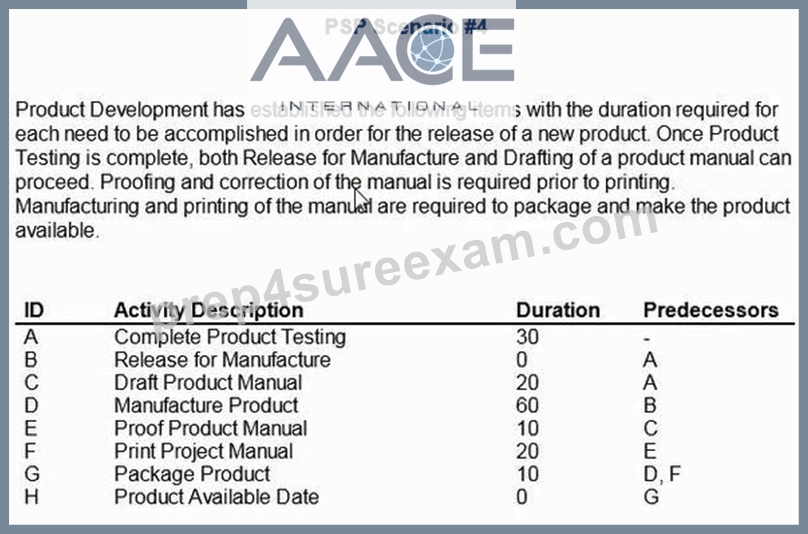
- A. Delay manufacturing by 5 days.
- B. Expedite printing by 5 days.
- C. Expedite packaging by 5 days.
- D. Delay product release by 5 days.
Answer: D
NEW QUESTION 29
Crane operators require 1 hour prep and 1 hour clean-up and inspection per day. There is only 1 crane operator allocated per crane. Crane operators are not allowed to work more than 8 hours a day. Lunchtime break lasts 1 hour. Assuming a 10 minute cycle time, how many lifts per day can be expected?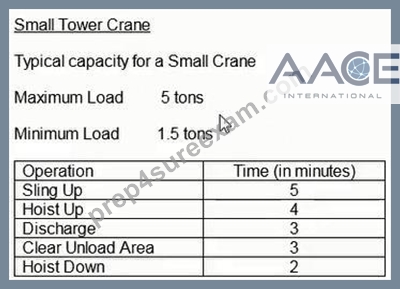
- A. 24 lifts
- B. 36 lifts
- C. 30 lifts
- D. 48 lifts
Answer: B
NEW QUESTION 30
Based on the stated costs, what percentage of the total cost comes from the 2000 series of activities?
- A. 3.9% (1 : 25.708)
- B. 2.3% (1 : 43.501).
- C. 8.6% (1 : 11.591)
- D. 9.1% (1 : 11.000).
Answer: B
NEW QUESTION 31
You are developing a detailed critical path schedule for a proposed petrochemical plant. The schedule will become a part of the project baseline document, which will be sent to the company's board of directors for its consideration. What document or resource is likely to be MOST valuable in determining the schedule's work activity durations?
- A. The Petrochemical Industry New Plant Task Duration Handbook.
- B. Critical path schedules prepared by you for similar completed projects.
- C. The cost estimate for the plant prepared by your firm's estimating department.
- D. Industry publications.
Answer: B
NEW QUESTION 32
You are retained by a contractor who asks you to perform a simple as-planned versus as-built analysis (APAB) of a large hydro-electric dam project that took more than five years to complete. Your analysis will form the basis of a change order that requests a time extension. You suggest using a different methodology for quantifying the delay. Which of the following reasons for recommending a different analysis does NOT apply to a simple APAB analysis?
- A. Not suitable for projects with long durations.
- B. Not suitable for complicated projects with multiple planned critical paths.
- C. Less accurate as the analysis advances through the project.
- D. Accuracy is increased by inserting delaying events into the as-planned schedule.
Answer: D
NEW QUESTION 33
Activity C is a
- A. 1-day activity.
- B. Continuous activity.
- C. Milestone.
- D. Contentious activity.
Answer: C
NEW QUESTION 34
At the end of month one, did the delay to the parking structure foundation delay the project?
- A. NO.
- B. Yes, by 9 calendar days.
- C. Yes, by 4 calendar days.
- D. Yes, by 14 calendar days.
Answer: C
NEW QUESTION 35
How much Total Float does drafting the product manual have?
- A. 10 workdays.
- B. 15 workdays.
- C. 0 workdays.
- D. 5 workdays.
Answer: A
NEW QUESTION 36
What is the primary difference between the arrow diagramming method (ADM) and the precedence diagramming method (PDM)?
- A. ADM is limited to finish-to-start logic relationships, while PDM is not.
- B. PDM is a bar chart with network logic, while ADM is a pure logic network.
- C. ADM uses arrows, while PDM uses boxes.
- D. ADM is manual CPM calculations, while PDM is computerized.
Answer: A
NEW QUESTION 37
Management has determined the need to release the product 20 days earlier than planned. What tasks need to be expedited?
- A. Drafting and Proofing the Manual.
- B. Testing, Manufacturing and Packaging.
- C. Printing the Manual.
- D. Packaging only.
Answer: B
NEW QUESTION 38
What is the remaining work duration of Active D?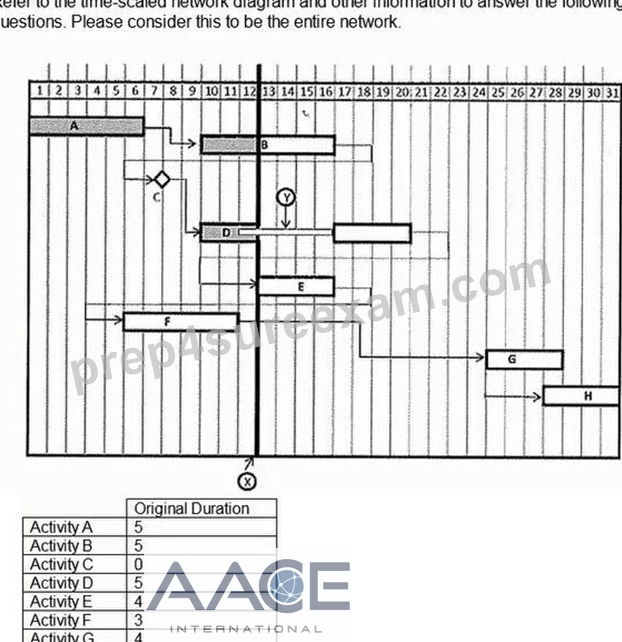
- A. 8.
- B. 3.
- C. 4.
- D. 0
Answer: C
NEW QUESTION 39
Using the "normal" schedule, if you start Activity 7001 on April 1, 2002, and using a 5-day workweek, what the finish date for Activity 7001?
- A. 06-11-02.
- B. 06-18-02.
- C. 06-05-02.
- D. 06-04-02.
Answer: C
NEW QUESTION 40
Using the "normal" schedule, theoretically construct a hammock for activities 2001 through 2004. What is the duration of the hammock?
- A. 91 days
- B. 168 days
- C. 193 days
- D. 183 days
Answer: D
NEW QUESTION 41
......
AACE-PSP Dumps for AACE Certification Certified Exam Questions & Answer: https://www.prep4sureexam.com/AACE-PSP-dumps-torrent.html
AACE-PSP Free Exam Study Guide! (Updated 120 Questions): https://drive.google.com/open?id=1TkUJrrqFhYYwC3bqH_Nambozuma3SPxo