

Pass Your Databricks Databricks-Certified-Data-Engineer-Associate Exam with Correct 102 Questions and Answers
Latest [Feb 27, 2025] 2025 Realistic Verified Databricks-Certified-Data-Engineer-Associate Dumps
Databricks Databricks-Certified-Data-Engineer-Associate Exam Syllabus Topics:
| Topic | Details |
|---|---|
| Topic 1 |
|
| Topic 2 |
|
| Topic 3 |
|
| Topic 4 |
|
| Topic 5 |
|
The GAQM Databricks-Certified-Data-Engineer-Associate (Databricks Certified Data Engineer Associate) Certification Exam is designed for individuals who are interested in pursuing a career in data engineering. Databricks Certified Data Engineer Associate Exam certification exam is developed in collaboration with Databricks, a leading data and AI company that provides a unified analytics platform for data engineering, data science, and machine learning. The Databricks-Certified-Data-Engineer-Associate exam tests candidates on their knowledge of data engineering principles, practices, and tools.
NEW QUESTION # 27
A data engineer needs to create a table in Databricks using data from their organization's existing SQLite database.
They run the following command: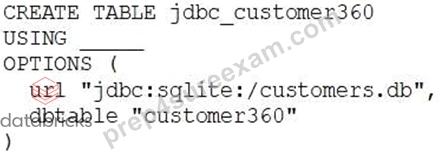
Which of the following lines of code fills in the above blank to successfully complete the task?
- A. org.apache.spark.sql.jdbc
- B. DELTA
- C. autoloader
- D. sqlite
- E. org.apache.spark.sql.sqlite
Answer: D
Explanation:
In the given command, a data engineer is trying to create a table in Databricks using data from an SQLite database. The correct option to fill in the blank is "sqlite" because it specifies the type of database being connected to in a JDBC connection string. The USING clause should be followed by the format of the data, and since we are connecting to an SQLite database, "sqlite" would be appropriate here. References:
* Create a table using JDBC
* JDBC connection string
* SQLite JDBC driver
NEW QUESTION # 28
Which of the following describes a benefit of creating an external table from Parquet rather than CSV when using a CREATE TABLE AS SELECT statement?
- A. Parquet files have a well-defined schema
- B. Parquet files have the ability to be optimized
- C. CREATE TABLE AS SELECT statements cannot be used on files
- D. Parquet files can be partitioned
- E. Parquet files will become Delta tables
Answer: A
Explanation:
Explanation
https://www.databricks.com/glossary/what-is-parquet#:~:text=Columnar%20storage%20like%20Apache%20Par Columnar storage like Apache Parquet is designed to bring efficiency compared to row-based files like CSV.
When querying, columnar storage you can skip over the non-relevant data very quickly. As a result, aggregation queries are less time-consuming compared to row-oriented databases.
NEW QUESTION # 29
An engineering manager uses a Databricks SQL query to monitor ingestion latency for each data source. The manager checks the results of the query every day, but they are manually rerunning the query each day and waiting for the results.
Which of the following approaches can the manager use to ensure the results of the query are updated each day?
- A. They can schedule the query to refresh every 1 day from the query's page in Databricks SQL.
- B. They can schedule the query to refresh every 12 hours from the SQL endpoint's page in Databricks SQL.
- C. They can schedule the query to run every 1 day from the Jobs UI.
- D. They can schedule the query to refresh every 1 day from the SQL endpoint's page in Databricks SQL.
- E. They can schedule the query to run every 12 hours from the Jobs UI.
Answer: A
Explanation:
Explanation
https://docs.databricks.com/en/sql/user/queries/schedule-query.html
NEW QUESTION # 30
A single Job runs two notebooks as two separate tasks. A data engineer has noticed that one of the notebooks is running slowly in the Job's current run. The data engineer asks a tech lead for help in identifying why this might be the case.
Which of the following approaches can the tech lead use to identify why the notebook is running slowly as part of the Job?
- A. They can navigate to the Tasks tab in the Jobs UI to immediately review the processing notebook.
- B. There is no way to determine why a Job task is running slowly.
- C. They can navigate to the Tasks tab in the Jobs UI and click on the active run to review the processing notebook.
- D. They can navigate to the Runs tab in the Jobs UI and click on the active run to review the processing notebook.
- E. They can navigate to the Runs tab in the Jobs UI to immediately review the processing notebook.
Answer: C
Explanation:
The Tasks tab in the Jobs UI shows the list of tasks that are part of a job, and allows the user to view the details of each task, such as the notebook path, the cluster configuration, the run status, and the duration. By clicking on the active run of a task, the user can access the Spark UI, the notebook output, and the logs of the task. These can help the user to identify the performance bottlenecks and errors in the task. The Runs tab in the Jobs UI only shows the summary of the job runs, such as the start time, the end time, the trigger, and the status. It does not provide the details of the individual tasks within a job run. References: Jobs UI, Monitor running jobs with a Job Run dashboard, How to optimize jobs performance
NEW QUESTION # 31
Which of the following tools is used by Auto Loader process data incrementally?
- A. Unity Catalog
- B. Checkpointing
- C. Spark Structured Streaming
- D. Databricks SQL
- E. Data Explorer
Answer: C
Explanation:
Auto Loader provides a Structured Streaming source called cloudFiles that can process new data files as they arrive in cloud storage without any additional setup. Auto Loader uses a scalable key-value store to track ingestion progress and ensure exactly-once semantics. Auto Loader can ingest various file formats and load them into Delta Lake tables. Auto Loader is recommended for incremental data ingestion with Delta Live Tables, which extends the functionality of Structured Streaming and allows you to write declarative Python or SQL code to deploy a production-quality data pipeline. Reference: What is Auto Loader?, What is Auto Loader? | Databricks on AWS, Solved: How does Auto Loader ingest data? - Databricks - 5629
NEW QUESTION # 32
Which of the following is a benefit of the Databricks Lakehouse Platform embracing open source technologies?
- A. Ability to scale storage
- B. Avoiding vendor lock-in
- C. Cloud-specific integrations
- D. Simplified governance
- E. Ability to scale workloads
Answer: B
Explanation:
One of the benefits of the Databricks Lakehouse Platform embracing open source technologies is that it avoids vendor lock-in. This means that customers can use the same open source tools and frameworks across different cloud providers, and migrate their data and workloads without being tied to a specific vendor. The Databricks Lakehouse Platform is built on open source projects such as Apache Spark™, Delta Lake, MLflow, and Redash, which are widely used and trusted by millions of developers. By supporting these open source technologies, the DatabricksLakehouse Platform enables customers to leverage the innovation and community of the open source ecosystem, and avoid the risk of being locked into proprietary or closed solutions. The other options are either not related to open source technologies (A, B, C, D), or not benefits of the Databricks Lakehouse Platform (A, B). References: Databricks Documentation - Built on open source, Databricks Documentation - What is the Lakehouse Platform?, Databricks Blog - Introducing the Databricks Lakehouse Platform.
NEW QUESTION # 33
Which of the following commands can be used to write data into a Delta table while avoiding the writing of duplicate records?
- A. IGNORE
- B. APPEND
- C. MERGE
- D. DROP
- E. INSERT
Answer: C
Explanation:
Explanation
To write data into a Delta table while avoiding the writing of duplicate records, you can use the MERGE command. The MERGE command in Delta Lake allows you to combine the ability to insert new records and update existing records in a single atomic operation. The MERGE command compares the data being written with the existing data in the Delta table based on specified matching criteria, typically using a primary key or unique identifier. It then performs conditional actions, such as inserting new records or updating existing records, depending on the comparison results. By using the MERGE command, you can handle the prevention of duplicate records in a more controlled and efficient manner. It allows you to synchronize and reconcile data from different sources while avoiding duplication and ensuring data integrity.
NEW QUESTION # 34
Which of the following describes a scenario in which a data team will want to utilize cluster pools?
- A. An automated report needs to be version-controlled across multiple collaborators.
- B. An automated report needs to be made reproducible.
- C. An automated report needs to be runnable by all stakeholders.
- D. An automated report needs to be tested to identify errors.
- E. An automated report needs to be refreshed as quickly as possible.
Answer: E
Explanation:
Databricks cluster pools are a set of idle, ready-to-use instances that can reduce cluster start and auto-scaling times. This is useful for scenarios where a data team needs to run an automated report as quickly as possible, without waiting for the cluster to launch or scale up. Cluster pools can also help save costs by reusing idle instances across different clusters and avoiding DBU charges for idle instances in the pool. References: Best practices: pools | Databricks on AWS, Best practices: pools - Azure Databricks | Microsoft Learn, Best practices: pools | Databricks on Google Cloud
NEW QUESTION # 35
A data engineer has been using a Databricks SQL dashboard to monitor the cleanliness of the input data to an ELT job. The ELT job has its Databricks SQL query that returns the number of input records containing unexpected NULL values. The data engineer wants their entire team to be notified via a messaging webhook whenever this value reaches 100.
Which of the following approaches can the data engineer use to notify their entire team via a messaging webhook whenever the number of NULL values reaches 100?
- A. They can set up an Alert with a new webhook alert destination.
- B. They can set up an Alert with a new email alert destination.
- C. They can set up an Alert with a custom template.
- D. They can set up an Alert without notifications.
- E. They can set up an Alert with one-time notifications.
Answer: A
Explanation:
A webhook alert destination is a way to send notifications to external applications or services via HTTP requests. A data engineer can use a webhook alert destination to notify their entire team via a messaging webhook, such as Slack or Microsoft Teams, whenever the number of NULL values in the input data reaches
100. To set up a webhook alert destination, the data engineer needs to do the following steps:
* In the Databricks SQL workspace, navigate to the Settings gear icon and select SQL Admin Console.
* Click Alert Destinations and click Add New Alert Destination.
* Select Webhook and enter the webhook URL and the optional custom template for the notification message.
* Click Create to save the webhook alert destination.
* In the Databricks SQL editor, create or open the query that returns the number of input records containing unexpected NULL values.
* Click the Create Alert icon above the editor window and configure the alert criteria, such as the value column, the condition, and the threshold.
* In the Notification section, select the webhook alert destination that was created earlier and click Create Alert. References: What are Databricks SQL alerts?, Monitor alerts, Monitoring Your Business with Alerts, Using Automation Runbook Webhooks To Alert on Databricks Status Updates.
NEW QUESTION # 36
A data engineer and data analyst are working together on a data pipeline. The data engineer is working on the raw, bronze, and silver layers of the pipeline using Python, and the data analyst is working on the gold layer of the pipeline using SQL The raw source of the pipeline is a streaming input. They now want to migrate their pipeline to use Delta Live Tables.
Which change will need to be made to the pipeline when migrating to Delta Live Tables?
- A. The pipeline will need to be written entirely in Python.
- B. The pipeline will need to be written entirely in SQL.
- C. The pipeline will need to use a batch source in place of a streaming source.
- D. The pipeline can have different notebook sources in SQL & Python.
Answer: D
Explanation:
When migrating to Delta Live Tables (DLT) with a data pipeline that involves different programming languages across various data layers, the migration does not require unifying the pipeline into a single language. Delta Live Tables support multi-language pipelines, allowing data engineers and data analysts to work in their preferred languages, such as Python for data engineering tasks (raw, bronze, and silver layers) and SQL for data analytics tasks (gold layer). This capability is particularly beneficial in collaborative settings and leverages the strengths of each language for different stages of data processing.
Reference:
Databricks documentation on Delta Live Tables: Delta Live Tables Guide
NEW QUESTION # 37
An engineering manager wants to monitor the performance of a recent project using a Databricks SQL query.
For the first week following the project's release, the manager wants the query results to be updated every minute. However, the manager is concerned that the compute resources used for the query will be left running and cost the organization a lot of money beyond the first week of the project's release.
Which of the following approaches can the engineering team use to ensure the query does not cost the organization any money beyond the first week of the project's release?
- A. They can set a limit to the number of individuals that are able to manage the query's refresh schedule.
- B. They can set the query's refresh schedule to end on a certain date in the query scheduler.
- C. They can set the query's refresh schedule to end after a certain number of refreshes.
- D. They can set a limit to the number of DBUs that are consumed by the SQL Endpoint.
- E. They cannot ensure the query does not cost the organization money beyond the first week of the project's release.
Answer: B
Explanation:
Explanation
If a dashboard is configured for automatic updates, it has a Scheduled button at the top, rather than a Schedule button. To stop automatically updating the dashboard and remove its subscriptions:
Click Scheduled.
In the Refresh every drop-down, select Never.
Click Save. The Scheduled button label changes to Schedule.
Source:https://learn.microsoft.com/en-us/azure/databricks/sql/user/dashboards/
NEW QUESTION # 38
A data analyst has a series of queries in a SQL program. The data analyst wants this program to run every day.
They only want the final query in the program to run on Sundays. They ask for help from the data engineering team to complete this task.
Which of the following approaches could be used by the data engineering team to complete this task?
- A. They could submit a feature request with Databricks to add this functionality.
- B. They could redesign the data model to separate the data used in the final query into a new table.
- C. They could wrap the queries using PySpark and use Python's control flow system to determine when to run the final query.
- D. They could automatically restrict access to the source table in the final query so that it is only accessible on Sundays.
- E. They could only run the entire program on Sundays.
Answer: C
Explanation:
This approach would allow the data engineering team to use the existing SQL program and add some logic to control the execution of the final query based on the day of the week. They could use the datetime module in Python to get the current date and check if it is a Sunday. If so, they could run the final query, otherwise they could skip it. This way, they could schedule the program to run every day without changing the data model or the source table. References: PySpark SQL Module, Python datetime Module, Databricks Jobs
NEW QUESTION # 39
A dataset has been defined using Delta Live Tables and includes an expectations clause:
CONSTRAINT valid_timestamp EXPECT (timestamp > '2020-01-01') ON VIOLATION FAIL UPDATE What is the expected behavior when a batch of data containing data that violates these constraints is processed?
- A. Records that violate the expectation are added to the target dataset and recorded as invalid in the event log.
- B. Records that violate the expectation are added to the target dataset and flagged as invalid in a field added to the target dataset.
- C. Records that violate the expectation cause the job to fail.
- D. Records that violate the expectation are dropped from the target dataset and loaded into a quarantine table.
- E. Records that violate the expectation are dropped from the target dataset and recorded as invalid in the event log.
Answer: C
Explanation:
Explanation
https://docs.databricks.com/en/delta-live-tables/expectations.html
Action
Result
warn (default)
Invalid records are written to the target; failure is reported as a metric for the dataset.
drop
Invalid records are dropped before data is written to the target; failure is reported as a metrics for the dataset.
fail
Invalid records prevent the update from succeeding. Manual intervention is required before re-processing.
NEW QUESTION # 40
A data engineer is using the following code block as part of a batch ingestion pipeline to read from a composable table: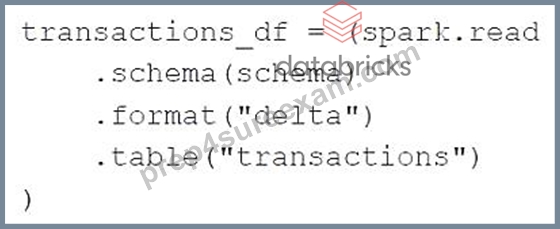
Which of the following changes needs to be made so this code block will work when the transactions table is a stream source?
- A. Replace schema(schema) with option ("maxFilesPerTrigger", 1)
- B. Replace format("delta") with format("stream")
- C. Replace "transactions" with the path to the location of the Delta table
- D. Replace spark.read with spark.readStream
- E. Replace predict with a stream-friendly prediction function
Answer: D
Explanation:
To read from a stream source, the data engineer needs to use the spark.readStream method instead of the spark.read method. The spark.readStream method returns a DataStreamReader object that can be used to specify the details of the input source, such as the format, the schema, the path, and the options. The spark.read method is only suitable for batch processing, not streaming processing. The other changes are not necessary or correct for reading from a stream source. References: Structured Streaming Programming Guide, Read a stream, Databricks Data Sources
NEW QUESTION # 41
A data engineer has a single-task Job that runs each morning before they begin working. After identifying an upstream data issue, they need to set up another task to run a new notebook prior to the original task.
Which of the following approaches can the data engineer use to set up the new task?
- A. They can create a new task in the existing Job and then add the original task as a dependency of the new task.
- B. They can clone the existing task to a new Job and then edit it to run the new notebook.
- C. They can clone the existing task in the existing Job and update it to run the new notebook.
- D. They can create a new job from scratch and add both tasks to run concurrently.
- E. They can create a new task in the existing Job and then add it as a dependency of the original task.
Answer: E
Explanation:
To set up the new task to run a new notebook prior to the original task in a single-task Job, the data engineer can use the following approach: In the existing Job, create a new task that corresponds to the new notebook that needs to be run. Set up the new task with the appropriate configuration, specifying the notebook to be executed and any necessary parameters or dependencies. Once the new task is created, designate it as a dependency of the original task in the Job configuration. This ensures that the new task is executed before the original task.
NEW QUESTION # 42
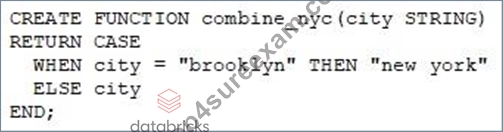
A data engineer needs to apply custom logic to string column city in table stores for a specific use case. In order to apply this custom logic at scale, the data engineer wants to create a SQL user-defined function (UDF).
Which of the following code blocks creates this SQL UDF?
- A.
- B.
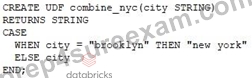
- C.
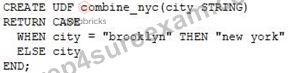
- D.
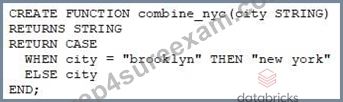
- E.
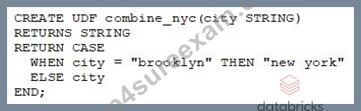
Answer: D
Explanation:
Explanation
https://www.databricks.com/blog/2021/10/20/introducing-sql-user-defined-functions.html
NEW QUESTION # 43
Which of the following benefits is provided by the array functions from Spark SQL?
- A. An ability to work with complex, nested data ingested from JSON files
- B. An ability to work with an array of tables for procedural automation
- C. An ability to work with data in a variety of types at once
- D. An ability to work with time-related data in specified intervals
- E. An ability to work with data within certain partitions and windows
Answer: E
NEW QUESTION # 44
In which of the following scenarios should a data engineer select a Task in the Depends On field of a new Databricks Job Task?
- A. When another task has the same dependency libraries as the new task
- B. When another task needs to successfully complete before the new task begins
- C. When another task needs to be replaced by the new task
- D. When another task needs to fail before the new task begins
- E. When another task needs to use as little compute resources as possible
Answer: B
NEW QUESTION # 45
A data engineer is designing a data pipeline. The source system generates files in a shared directory that is also used by other processes. As a result, the files should be kept as is and will accumulate in the directory. The data engineer needs to identify which files are new since the previous run in the pipeline, and set up the pipeline to only ingest those new files with each run.
Which of the following tools can the data engineer use to solve this problem?
- A. Unity Catalog
- B. Databricks SQL
- C. Auto Loader
- D. Data Explorer
- E. Delta Lake
Answer: C
Explanation:
Auto Loader is a tool that can incrementally and efficiently process new data files as they arrive in cloud storage without any additional setup. Auto Loader provides a Structured Streaming source called cloudFiles, which automatically detects and processes new files in a given input directory path on the cloud file storage. Auto Loader also tracks the ingestion progress and ensures exactly-once semantics when writing data into Delta Lake. Auto Loader can ingest various file formats, such as JSON, CSV, XML, PARQUET, AVRO, ORC, TEXT, and BINARYFILE. Auto Loader has support for both Python and SQL in Delta Live Tables, which are a declarative way to build production-quality data pipelines with Databricks. Reference: What is Auto Loader?, Get started with Databricks Auto Loader, Auto Loader in Delta Live Tables
NEW QUESTION # 46
A data engineer needs to create a table in Databricks using data from a CSV file at location /path/to/csv.
They run the following command: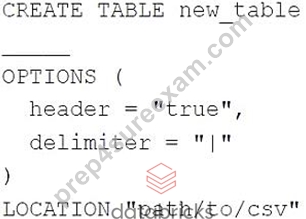
Which of the following lines of code fills in the above blank to successfully complete the task?
- A. USING DELTA
- B. None of these lines of code are needed to successfully complete the task
- C. USING CSV
- D. FROM "path/to/csv"
- E. FROM CSV
Answer: D
Explanation:
A data lakehouse is a new paradigm that can be used to simplify and unify siloed data architectures that are specialized for specific use cases. A data lakehouse combines the best of both data lakes and data warehouses, providing a single platform that supports diverse data types, open standards, low-cost storage, high-performance queries, ACID transactions, schema enforcement, and governance. A data lakehouse enables data engineers to build reliable and scalable data pipelines that can serve various downstream applications and users, such as data science, machine learning, analytics, and reporting. A data lakehouse leverages the power of Delta Lake, a storage layer that brings reliability and performance to data lakes. Reference: What is a data lakehouse?, Delta Lake, Lakehouse: A New Generation of Open Platforms that Unify Data Warehousing and Advanced Analytics
NEW QUESTION # 47
......
Get 2025 Updated Free Databricks Databricks-Certified-Data-Engineer-Associate Exam Questions and Answer: https://www.prep4sureexam.com/Databricks-Certified-Data-Engineer-Associate-dumps-torrent.html