

SPHR Practice HRCI Verified Answers - Pass Your Exams For Sure! [2025]
Valid Way To Pass HRCI Certifications's SPHR Exam
HRCI SPHR exam is a certification exam for professionals in the field of human resources. SPHR exam is designed to test the candidate's knowledge and skills in various areas of human resources management. SPHR exam is offered by the Human Resource Certification Institute (HRCI), which is a globally recognized organization that provides certification programs for HR professionals.
NEW QUESTION # 31
An organization has over 5,000 employees who are members of a union. The employees, however, are no longer happy with the union's performance and they would like to decertify the union from their representation. Who will decertify the union in this instance?
- A. Management of the employees
- B. The employees
- C. The National Labor Relations Board
- D. The union official if fifty percent of the employees sign off on the decertification
Answer: C
Explanation:
Explanation/Reference:
Answer option B is correct.
Certification and decertification of union representation is managed by the National Labor Relations Board.
Answer option C is incorrect. Management does not decertify the union; the NLRB does.
Answer option D is incorrect. The employees can demand the change if they have 30 percent of the employee signatures.
Answer option A is incorrect. The union doesn't decertify the employees; the NLRB does.
Reference: Professional in Human Resources Certification Guide, Sybex, ISBN: 978-0-470-43096-5.
Chapter 7: Employee and Labor Relations. Official PHR and SPHR Certification Guide, HR Certification Institute, ISBN: 978-1-586-44149-4, Section III, The US Body of Knowledge.
Chapter: Employee and Labor Relations
Objective: Federal Employment Legislation
NEW QUESTION # 32
An organization requires that all new managers must complete the first six months of their assignment traveling to different geographical locales. Female employees feel that this requirement restricts them from management positions because they have family obligations that would prevent them from traveling. The requirement to travel for six months is likely an example of what type of discrimination in this instance?
- A. Political requirement
- B. Disparate treatment
- C. Sexual harassment
- D. Disparate impact
Answer: D
Explanation:
Reference: Professional in Human Resources Certification Study Guide, Sybex, ISBN: 9780-470-43096-5. Chapter Four: Workforce Planning. Official PHR and SPHR Certification Guide, HR Certification Institute, ISBN: 978-1-586-44149-4, Section III, The US Body of Knowledge.
Chapter: Workforce Planning and Employment
Objective: Federal Employment Legislation
NEW QUESTION # 33
DRAG DROP
Drag and drop the types of picketing beside their corresponding descriptions.
Select and Place: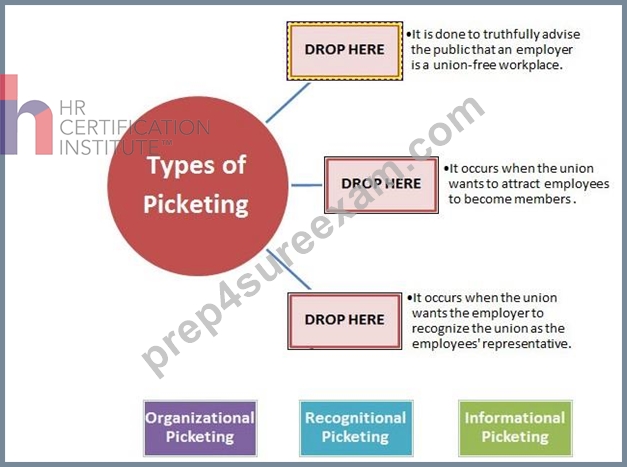
Answer:
Explanation: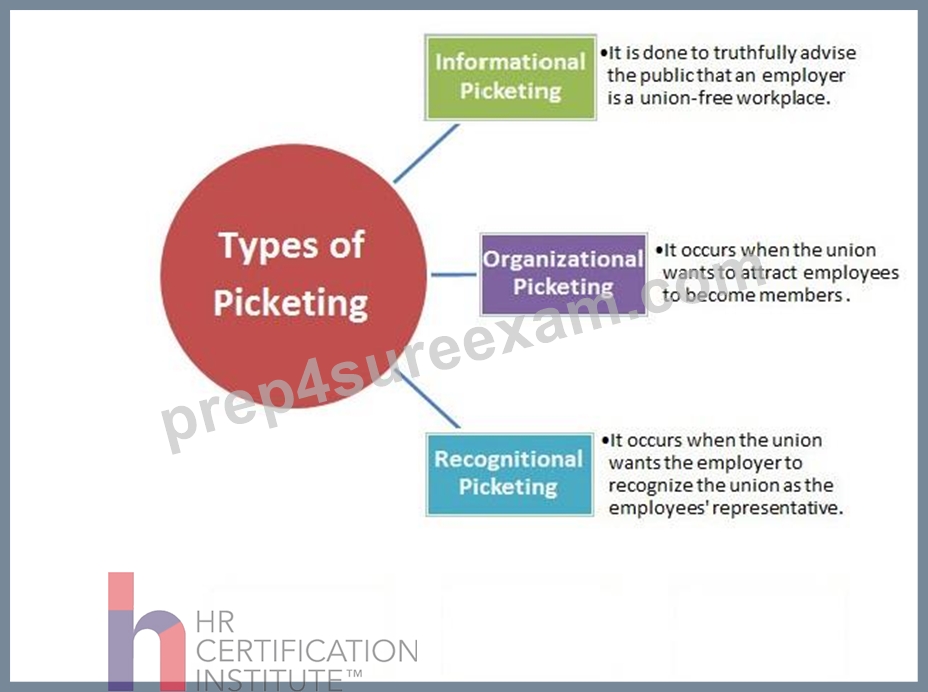
Explanation/Reference:
The types of picketing are as follows: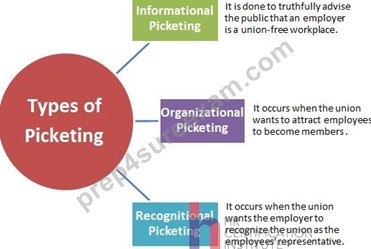
Chapter: Employee and Labor Relations
Objective: Union Organization
NEW QUESTION # 34
Which of the following prohibits employers from hiring undocumented workers?
- A. IRCA
- B. FECA
- C. OSHA
- D. FLSA
Answer: A
Explanation:
Explanation/Reference:
Answer option A is correct.
The IRCA, or Immigration Reform and Control Act of 1986, prohibits employers from hiring undocumented workers (sometimes called illegal aliens). It is an Act of Congress which reformed United States immigration law.
Answer option D is incorrect. OSHA stands for Occupational Safety and Health Administration. OSHA is an agency of the United States Department of Labor. It was created by Congress of the United States under the Occupational Safety and Health Act, signed by President Richard M Nixon, on December 29, 1970. Its mission is to prevent work-related injuries, illnesses, and occupational fatality by issuing and enforcing standards for workplace safety and health. The agency is headed by a Deputy Assistant Secretary of Labor. OSHA issues guidelines and regulations for the safe use of a computer.
Answer option C is incorrect. The Fair Labor Standards Act (FLSA) defines a list of jobs not suitable for children between the ages of 16 and 18.
Answer option B is incorrect. Federal Employees Compensation Act (FECA) is a law that provides rules for compensation benefits to federal employees for work-related injuries or illnesses. FECA contains legal provision for giving compensation to their surviving dependents if a work-related injury or illness results in the employee's death.
Chapter: Workforce Planning and Employment
Objective: Staffing Programs
NEW QUESTION # 35
You are leading a brief presentation for your company about the ERISA program your company participates in. What is ERISA used for?
- A. It protects the interests of those who participate in employee benefit plans
- B. It protects the workers of employee compensation plans
- C. It allows private organizations to create investments for workers in profit-sharing plans
- D. It protects private organizations that have profit sharing plans for employee compensation
Answer: A
Explanation:
Reference: PHR Exam Prep, Pearson Education, ISBN: 978-0-7897-3677-2. Chapter Six: Total Rewards. Official PHR and SPHR Certification Guide, HR Certification Institute, ISBN: 978-1-586-44149-4, Section III, The US HR Body of Knowledge.
Chapter: Compensation and Benefits
Objective: Benefits
NEW QUESTION # 36
Assessing alignment between the organization's vision and HR processes can best be achieved by:
- A. Conducting exit interviews
- B. Requiring compliance monitoring
- C. Engaging with stakeholders
- D. Coordinating an external audit
Answer: C
Explanation:
Stakeholder engagementis essential to ensure HR processes support and reflect thestrategic direction of the organization. It provides qualitative insight into alignment between HR actions and the company's long-term mission.
Extract from HRCI-aligned HR knowledge (Leadership and Strategy):
SPHR-level HR strategy emphasizes "engaging key stakeholders to validate HR contributions to organizational vision." Stakeholder feedback informs decisions, exposes misalignments, and ensures strategic unity.
NEW QUESTION # 37
Which of the following are the primary factors that would contribute to a hiring manager's decision to extend an offer above the midpoint of a salary range? (Select TWO options.)
- A. The position is of average complexity and competition is high for talent
- B. The candidate has a strong skill set including specialized certifications
- C. The candidate currently works in a similar position with a direct competitor
- D. The position has some complexity and competition is moderate for talent
- E. The candidate has the needed level of experience for the position
Answer: B,C
Explanation:
When extending offersabove the midpoint, HR must justify that decision based oncritical qualifications or competitive risks.
* Option Brefers to a candidate withspecialized certifications and a strong skill set, whichadds strategic valueand warrants a premium.
* Option Ereflectscompetitive poaching; to attract talent from adirect competitor, especially with transferable experience, HR may offer acompensatory advantage.
Extract from HRCI-aligned HR knowledge (Total Rewards domain):
"Total Rewards strategies must account for market competitiveness, internal equity, and candidate-specific value propositions." Offering above midpoint should be based on "experience above minimum qualifications, hard-to-find certifications, or risk of losing talent to a competitor." The SPHR model requires thatoffers be aligned with compensation strategy, which accounts for market dataandinternal compensation structure.
NEW QUESTION # 38
For purposes of developing a security program, an HR manager must assess potential risks and costs related to loss and protection. Which factor must the manager first examine?
- A. Cost of the loss, including a permanent or temporary substitute
- B. Degree of probability that the loss will occur
- C. Severity of impact of the loss to the organization
- D. Availability and cost of insurance to cover the loss
Answer: B
Explanation:
Answer option C is correct.The significance of various security issues depends partly on the size of the organization. However, regardless of size, the same considerations go into assessing vulnerabilities and the method for estimating the cost of potential losses. The justification of such a program requires that the potential losses will exceed the cost of the program. See Chapter 8 for more information. Chapter: Risk Management Objective: Risk Management
NEW QUESTION # 39
"When the workplace is permeated with discriminatory intimidation, ridicule and insult that is sufficiently severe or pervasive to alter the conditions of the victim's employment and create an abusive working environment, Title VII is violated." This is a statement made with regard to which of the following sexual-harassment court cases?
- A. Oncale v. Sundowner Offshore Services
- B. Burlington Industries v. Ellerth
- C. Harris v. Forklift Systems, Inc.
- D. Faragher v. City of Boca Raton
Answer: C
Explanation:
Answer option A is correct.Harris v. Forklift Systems Inc. was referenced in the case of same-sex harassment brought to the Supreme Court in Oncale v. Sundowner (D). Oncale helped determine that gender is of little consequence when harassment meets the statutory requirements defined in Harris. Faragher v. City of Boca Raton (B) and Burlington Industries v. Ellerth (C) were also important cases aiding in interpreting the concept of sexual harassment in the workplace. Chapter: Employee and Labor Relations Objective: Review Questions
NEW QUESTION # 40
Which of the following Acts establishes mandatory safety and health standards for mine operators and monitors operations throughout the United States?
- A. SBREF act
- B. MSH act
- C. FLS act
- D. OSH act
Answer: B
Explanation:
Explanation/Reference:
Answer option D is correct.
Chapter: Risk Management
Objective: Risk Assessment
NEW QUESTION # 41
Professionals, craft workers, and laborers/helpers have what in common?
- A. They are all examples of types of labor unions.
- B. They are all classifications for defining exempt workers.
- C. They are all job categories on the EEO-1 report.
- D. They are all examples of protected-class individuals.
Answer: C
Explanation:
Explanation/Reference:
Answer option B is correct.
The EEO-1 report requires employers to group jobs into job categories based on average skill level, knowledge, and responsibility. Exempt workers are defined by professional, executive, and administrative exemption criteria (C), and these are not examples of the protected class groups under federal law (A).
Chapter: Workforce Planning and Employment
Objective: Review Questions
NEW QUESTION # 42
During an I-9 audit, the following errors are discovered: three I-9 forms for current employees cannot be located, two forms are missing the employer signature, and all forms are maintained in a shared, unlocked file cabinet.
Completion of new I-9 forms for the three employees whose forms cannot be located will:
- A. demonstrate a good faith effort
- B. sufficiently correct the error
- C. mandate a minimum penalty
- D. reduce the penalty by half
Answer: A
Explanation:
U.S. Citizenship and Immigration Services (USCIS) allows employers to mitigate penalties by taking corrective action. Completing new I-9s in a transparent mannershows a good faith effort, which is considered during audits or enforcement actions.
SPHR-level compliance strategies stress prompt correction anddemonstrable intent to comply, particularly with documentation regulations like the I-9.
NEW QUESTION # 43
Your company is going through a corporate restructuring process. Which of the following best describes corporate restructuring?
- A. Elimination of waste by reducing high-paid staff
- B. Outsourcing activities that have high costs, but low rewards
- C. Elimination of waste by reducing redundancy in staffing
- D. Elimination of waste by examining business units to eliminate redundancy and reduce overall costs
Answer: D
Explanation:
Explanation/Reference:
Answer option D is correct.
Corporate restructuring focuses on the business units, not the employees, to determine redundant activities, boundaries, wasted efforts, in an effort to operate more efficiently.
Answer option C is incorrect. This isn't a valid statement about corporate restructuring, as the focus is not on eliminating staff.
Answer option B is incorrect. Highly-paid staff isn't necessarily a waste, so this answer isn't the best choice.
Answer option A is incorrect. Outsourcing may be a by-product of restricting, but it's not the best answer to the question.
Reference: Professional in Human Resources Certification Study Guide, Sybex, ISBN: 978-0-470-43096-5.
Chapter Four: Workforce Planning and Employment. Official PHR and SPHR Certification Guide, HR Certification Institute, ISBN: 978-1-586-44149-4, Section III, The US Body of Knowledge.
Chapter: Business Management and Strategy
Objective: Strategic Management
NEW QUESTION # 44
Your organization is comprised of various functional units, such as sales, marketing, IT, and manufacturing. When projects are created in this structure, the project team members often come from all functional areas of the organization and may work on several projects at a time. What type of organization structure are you likely operating within?
- A. Blended
- B. Projectized
- C. Functional
- D. Matrix
Answer: D
Explanation:
Explanation/Reference:
Answer option D is correct.
A matrix structure allows resources to be used across the organization from different functional units within the company. There are three types of matrix structures: weak, strong, and balanced matrixes. The adjectives describe the amount of authority the project manager has, in relation to the amount of project authority the functional managers have.
Answer option C is incorrect. A functional structure keeps each functional unit isolated from using resources in other functional units. All Project team members exist within one functional unit.
Answer option A is incorrect. Blended is not a valid organizational term to describe the structure of an organization.
Answer option B is incorrect. A projectized organization keeps all project team members on one project for the duration of the project. Project team members don't necessarily have day-to-day functional duties and instead, focus all efforts on the completion of a given project.
Reference: PHR Exam Prep, Pearson Education, ISBN: 978-0-7897-3677-2. Chapter Three: Strategic Management. Official PHR and SPHR Certification Guide, HR Certification Institute, ISBN: 978-1-586-
44149-4, Section III, The US HR Body of Knowledge.
Chapter: Business Management and Strategy
Objective: Strategic Management
NEW QUESTION # 45
A summary plan description is not required for which of the following?
- A. AD&D insurance
- B. Defined-contribution plans
- C. Defined-benefit plans
- D. Flexible spending accounts
Answer: A
Explanation:
Answer option B is correct.Summary plan descriptions are required only for group health plans, and not for defined contribution plans, defined benefit plans, or FSAs. Chapter: Compensation and Benefits Objective: Review Questions
NEW QUESTION # 46
A manager always requires a female member of the project team to take the meeting minutes. This is an example of what type of discrimination?
- A. Disparate impact
- B. Disparate treatment
- C. Sexual harassment
- D. Adverse impact
Answer: B
Explanation:
Section: Volume A
Explanation/Reference:
Answer option B is correct.
This is an example of disparate treatment, as the manager always asks a female member of the project team to take the meeting minutes. The manager should rotate the assignment among men and women rather than consistently asking females to record the meeting minutes.
Answer option A is incorrect. This isn't an example of disparate impact, as there's no evident of a neutral policy that females must keep the meeting minutes.
Answer option C is incorrect. This isn't sexual harassment, as the manager is not making sexual advances in the scenario.
Answer option D is incorrect. Adverse impact is synonymous with disparate treatment.
Reference: Professional in Human Resources Certification Study Guide, Sybex, ISBN: 978-0-470-43096-5.
Chapter Four: Workforce Planning. Official PHR and SPHR Certification Guide, HR Certification Institute, ISBN: 978-1-586-44149-4, Section III, The US Body of Knowledge.
Chapter: Human Resource Development
Objective: Unique Employee Needs
NEW QUESTION # 47
Deal and Kennedy defined the four dimensions of organizational culture that you should be familiar with, as an HR Professional. What dimension of organizational culture is best defined by the hidden hierarchy of power?
- A. Heroes
- B. Values
- C. Culture network
- D. Joy
Answer: C
Explanation:
Reference: PHR Exam Prep, Pearson Education, ISBN: 978-0-7897-3677-2. Chapter Seven: Employee and Labor Relations. Official PHR and SPHR Certification Guide, HR Certification Institute, ISBN: 978-1-586-44149-4, Section III, The US HR Body of Knowledge.
Chapter: Employee and Labor Relations
Objective: Employee Relations
NEW QUESTION # 48
Human resources is often seen as a three-dimensional component of an organization. Which dimension of human resources focuses on long-term, future-focused approach to the methods to achieve human resource and organizational goals?
- A. Operational
- B. Strategic
- C. Administrative
- D. Organizational
Answer: B
Explanation:
Section: Volume C
Explanation/Reference:
Answer option A is correct.
The strategic component of human resources is a long-term, future-looking component of HR to achieve goals of the organization and the goals of human resources.
Answer option B is incorrect. Administrative describes the transactions within HR that are required to be completed either legally, through enterprise environmental factors, or both.
Answer option C is incorrect. Organizational is not one of the three dimensions of HR. The three dimensions are strategic, administration, and operational.
Answer option D is incorrect. Operational describes the tactics and operational goals of the organization being realized with the assistance of HR.
Reference: Professional in Human Resources Certification Study Guide, Sybex, ISBN: 978-0-470-43096-5.
Chapter Four: Workforce Planning and Employment. Official PHR and SPHR Certification Guide, HR Certification Institute, ISBN: 978-1-586-44149-4, Section III, The US Body of Knowledge.
Chapter: Business Management and Strategy
Objective: Strategy
NEW QUESTION # 49
Jane is preparing for an interview process for an open position within her company. Jane has prepared several questions for the interview. In her questions, Jane is careful not to ask all of the following questions, except for which one?
- A. How many children do you have?
- B. Where are you from?
- C. What's your date of birth?
- D. Our hours are from 8 AM to 5 PM. Can you meet this requirement of the position?
Answer: D
Explanation:
Section: Volume D
Explanation/Reference:
Answer option D is correct.
Of all the questions, only choice D is a valid question that Jane should ask. Jane must be careful, not to offer questions that could be or interpreted as discriminatory.
Answer option A is incorrect. By asking how many children the candidate has, is an example of sex discrimination.
Answer option B is incorrect. Jane may get national origin information in the question.
Answer option C is incorrect. Asking for one's date of birth could lead to age discrimination.
Reference: PHR Exam Prep, Pearson Education, ISBN: 978-0-7897-3677-2. Chapter Four: Workforce Planning and Employment. Official PHR and SPHR Certification Guide, HR Certification Institute, ISBN: 978-1-
586-44149, Section III, The US HR Body of Knowledge.
Chapter: Workforce Planning and Employment
Objective: Staffing Programs
NEW QUESTION # 50
One factor of the Uniform Guidelines on Employee Selection is reliability during interviews. Which of the following statements is the best description of reliability during interviews?
- A. Interviews should prepare and consistently use a list of job-related questions that will be asked of all candidates for all employment positions within the organization.
- B. Interviews should adapt job-related questions for each candidate for a particular position based on the candidate's experience.
- C. Interviews should prepare and consistently use questions that will be asked of all candidates based on the candidate's submitted resume.
- D. Interviews should prepare and consistently use a list of job-related questions that will be asked of all candidates for a particular position.
Answer: D
Explanation:
Reference: Professional in Human Resources Certification Study Guide, Sybex, ISBN: 9780-470-43096-5. Chapter Four: Workforce Planning. Official PHR and SPHR Certification Guide, HR Certification Institute, ISBN: 978-1-586-44149-4, Section III, The US Body of Knowledge.
Chapter: Workforce Planning and Employment
Objective: Staffing Programs
NEW QUESTION # 51
This nonmathematical forecasting technique brings the participants together to share and discuss their ideas about the forecast. The ideas are then ranked based on the groups input. What technique is discussed?
- A. Management forecasts
- B. Nominal group technique
- C. Brainstorming
- D. Delphi technique
Answer: B
Explanation:
Reference: Professional in Human Resources Certification Study Guide, Sybex, ISBN: 9780-470-43096-5. Chapter Four: Workforce Planning. Official PHR and SPHR Certification Guide, HR Certification Institute, ISBN: 978-1-586-44149-4, Section III, The US Body of Knowledge.
Chapter: Core Knowledge Requirements for HR Professionals
Objective: Qualitative and Quantitative Analysis
NEW QUESTION # 52
Which of the following is designed to give students opportunities to gain experience in their chosen fields prior to graduation?
- A. Merger
- B. Internship program
- C. Job sharing
- D. Outsourcing
Answer: B
Explanation:
Explanation/Reference:
Answer option D is correct.
Chapter: Workforce Planning and Employment
Objective: Strategic Workforce Planning
NEW QUESTION # 53
Which of the following has established standards for personal protective equipment (PPE)?
- A. Occupational Safety and Health Act (OSHA)
- B. Fair Labor Standards Act (FLSA)
- C. Mine Safety and Health Act (MSHA)
- D. Drug-Free Workplace Act
Answer: A
Explanation:
Explanation/Reference:
Answer option D is correct.
Chapter: Risk Management
Objective: Risk Assessment
NEW QUESTION # 54
......
HRCI SPHR Pre-Exam Practice Tests | Prep4sureExam: https://www.prep4sureexam.com/SPHR-dumps-torrent.html
SPHR practice test questions, answers, explanations: https://drive.google.com/open?id=151U-AmBUzXrp3N2PUKepC3wJ-7y2m91O