

Authentic Google Professional-Machine-Learning-Engineer Exam Dumps PDF - 2023 Updated
Get Prepared for Your Professional-Machine-Learning-Engineer Exam With Actual 150 Questions
Who should take the Professional Machine Learning Engineer - Google
A Professional Machine Learning Engineer designs, builds, and productionizes ML models to solve business challenges using Google Cloud technologies and knowledge of proven ML models and techniques. The ML Engineer collaborates closely with other job roles to ensure long-term success of models. The ML Engineer should be proficient in all aspects of model architecture, data pipeline interaction, and metrics interpretation. The ML Engineer needs familiarity with application development, infrastructure management, data engineering, and security. Through an understanding of training, retraining, deploying, scheduling, monitoring, and improving models, they design and create scalable solutions for optimal performance.
The Google Professional-Machine-Learning-Engineer exam is for entry-level IT specialists and organization professionals with standard knowledge of the Google platform. The Google CCP certification validates the potential client's understanding of these topics and their skills; standard building principles, key services and also their use cases, security, and protection, as well as compliance with the Google model, paid versions, and prices. Google Professional-Machine-Learning-Engineer exam is the appropriate starting point for Google certification and is also an excellent resource for those interested in non-technical projects.
NEW QUESTION # 87
You work for a retailer that sells clothes to customers around the world. You have been tasked with ensuring that ML models are built in a secure manner. Specifically, you need to protect sensitive customer data that might be used in the models. You have identified four fields containing sensitive data that are being used by your data science team: AGE, IS_EXISTING_CUSTOMER, LATITUDE_LONGITUDE, and SHIRT_SIZE. What should you do with the data before it is made available to the data science team for training purposes?
- A. Use principal component analysis (PCA) to reduce the four sensitive fields to one PCA vector.
- B. Remove all sensitive data fields, and ask the data science team to build their models using non-sensitive data.
- C. Coarsen the data by putting AGE into quantiles and rounding LATITUDE_LONGTTUDE into single precision. The other two fields are already as coarse as possible.
- D. Tokenize all of the fields using hashed dummy values to replace the real values.
Answer: D
NEW QUESTION # 88
You have trained a model on a dataset that required computationally expensive preprocessing operations. You need to execute the same preprocessing at prediction time. You deployed the model on Al Platform for high-throughput online prediction. Which architecture should you use?
- A. * Validate the accuracy of the model that you trained on preprocessed data
* Create a new model that uses the raw data and is available in real time
* Deploy the new model onto Al Platform for online prediction - B. * Stream incoming prediction request data into Cloud Spanner
* Create a view to abstract your preprocessing logic.
* Query the view every second for new records
* Submit a prediction request to Al Platform using the transformed data
* Write the predictions to an outbound Pub/Sub queue. - C. * Send incoming prediction requests to a Pub/Sub topic
* Transform the incoming data using a Dataflow job
* Submit a prediction request to Al Platform using the transformed data
* Write the predictions to an outbound Pub/Sub queue - D. * Send incoming prediction requests to a Pub/Sub topic
* Set up a Cloud Function that is triggered when messages are published to the Pub/Sub topic.
* Implement your preprocessing logic in the Cloud Function
* Submit a prediction request to Al Platform using the transformed data
* Write the predictions to an outbound Pub/Sub queue
Answer: C
Explanation:
https://cloud.google.com/architecture/data-preprocessing-for-ml-with-tf-transform-pt1#where_to_do_preprocessing
NEW QUESTION # 89
You are building a model to predict daily temperatures. You split the data randomly and then transformed the training and test datasets. Temperature data for model training is uploaded hourly. During testing, your model performed with 97% accuracy; however, after deploying to production, the model's accuracy dropped to 66%. How can you make your production model more accurate?
- A. Add more data to your test set to ensure that you have a fair distribution and sample for testing
- B. Normalize the data for the training, and test datasets as two separate steps.
- C. Split the training and test data based on time rather than a random split to avoid leakage
- D. Apply data transformations before splitting, and cross-validate to make sure that the transformations are applied to both the training and test sets.
Answer: A
NEW QUESTION # 90
You have written unit tests for a Kubeflow Pipeline that require custom libraries. You want to automate the execution of unit tests with each new push to your development branch in Cloud Source Repositories. What should you do?
- A. Set up a Cloud Logging sink to a Pub/Sub topic that captures interactions with Cloud Source Repositories Configure a Pub/Sub trigger for Cloud Run, and execute the unit tests on Cloud Run.
- B. Write a script that sequentially performs the push to your development branch and executes the unit tests on Cloud Run
- C. Using Cloud Build, set an automated trigger to execute the unit tests when changes are pushed to your development branch.
- D. Set up a Cloud Logging sink to a Pub/Sub topic that captures interactions with Cloud Source Repositories. Execute the unit tests using a Cloud Function that is triggered when messages are sent to the Pub/Sub topic
Answer: C
NEW QUESTION # 91
Your company manages a video sharing website where users can watch and upload videos. You need to create an ML model to predict which newly uploaded videos will be the most popular so that those videos can be prioritized on your company's website. Which result should you use to determine whether the model is successful?
- A. The Pearson correlation coefficient between the log-transformed number of views after 7 days and 30 days after publication is equal to 0.
- B. The model predicts 97.5% of the most popular clickbait videos measured by number of clicks.
- C. The model predicts 95% of the most popular videos measured by watch time within 30 days of being uploaded.
- D. The model predicts videos as popular if the user who uploads them has over 10,000 likes.
Answer: C
Explanation:
https://developers.google.com/machine-learning/problem-framing/framing#quantify-it
NEW QUESTION # 92
You have been asked to develop an input pipeline for an ML training model that processes images from disparate sources at a low latency. You discover that your input data does not fit in memory. How should you create a dataset following Google-recommended best practices?
- A. Convert the images to tf .Tensor Objects, and then run Dataset. from_tensor_slices{).
- B. Create a tf.data.Dataset.prefetch transformation
- C. Convert the images to tf .Tensor Objects, and then run tf. data. Dataset. from_tensors ().
- D. Convert the images Into TFRecords, store the images in Cloud Storage, and then use the tf. data API to read the images for training
Answer: A
NEW QUESTION # 93
You are designing an architecture with a serverless ML system to enrich customer support tickets with informative metadata before they are routed to a support agent. You need a set of models to predict ticket priority, predict ticket resolution time, and perform sentiment analysis to help agents make strategic decisions when they process support requests. Tickets are not expected to have any domain-specific terms or jargon.
The proposed architecture has the following flow:
Which endpoints should the Enrichment Cloud Functions call?
- A. 1 = Vertex Al. 2 = Vertex Al. 3 = AutoML Vision
- B. 1 = Cloud Natural Language API. 2 = Vertex Al, 3 = Cloud Vision API
- C. 1 = Vertex Al. 2 = Vertex Al. 3 = AutoML Natural Language
- D. 1 = Vertex Al. 2 = Vertex Al. 3 = Cloud Natural Language API
Answer: D
Explanation:
https://cloud.google.com/architecture/architecture-of-a-serverless-ml-model#architecture The architecture has the following flow:
A user writes a ticket to Firebase, which triggers a Cloud Function.
-The Cloud Function calls 3 different endpoints to enrich the ticket:
-An AI Platform endpoint, where the function can predict the priority.
-An AI Platform endpoint, where the function can predict the resolution time.
-The Natural Language API to do sentiment analysis and word salience.
-For each reply, the Cloud Function updates the Firebase real-time database.
-The Cloud Function then creates a ticket into the helpdesk platform using the RESTful API.
NEW QUESTION # 94
You have a functioning end-to-end ML pipeline that involves tuning the hyperparameters of your ML model using Al Platform, and then using the best-tuned parameters for training. Hypertuning is taking longer than expected and is delaying the downstream processes. You want to speed up the tuning job without significantly compromising its effectiveness. Which actions should you take?
Choose 2 answers
- A. Decrease the maximum number of trials during subsequent training phases.
- B. Decrease the range of floating-point values
- C. Decrease the number of parallel trials
- D. Change the search algorithm from Bayesian search to random search.
- E. Set the early stopping parameter to TRUE
Answer: B,D
NEW QUESTION # 95
You have been asked to build a model using a dataset that is stored in a medium-sized (~10 GB) BigQuery table. You need to quickly determine whether this data is suitable for model development. You want to create a one-time report that includes both informative visualizations of data distributions and more sophisticated statistical analyses to share with other ML engineers on your team. You require maximum flexibility to create your report. What should you do?
- A. Use Dataprep to create the report.
- B. Use the Google Data Studio to create the report.
- C. Use the output from TensorFlow Data Validation on Dataflow to generate the report.
- D. Use Vertex AI Workbench user-managed notebooks to generate the report.
Answer: C
NEW QUESTION # 96
You built and manage a production system that is responsible for predicting sales numbers. Model accuracy is crucial, because the production model is required to keep up with market changes. Since being deployed to production, the model hasn't changed; however the accuracy of the model has steadily deteriorated. What issue is most likely causing the steady decline in model accuracy?
- A. Lack of model retraining
- B. Too few layers in the model for capturing information
- C. Incorrect data split ratio during model training, evaluation, validation, and test
- D. Poor data quality
Answer: C
NEW QUESTION # 97
You need to build an ML model for a social media application to predict whether a user's submitted profile photo meets the requirements. The application will inform the user if the picture meets the requirements. How should you build a model to ensure that the application does not falsely accept a non-compliant picture?
- A. Use Vertex AI Workbench user-managed notebooks to build a custom model that has three times as many examples of pictures that meet the profile photo requirements.
- B. Use Vertex AI Workbench user-managed notebooks to build a custom model that has three times as many examples of pictures that do not meet the profile photo requirements.
- C. Use AutoML to optimize the model's F1 score in order to balance the accuracy of false positives and false negatives.
- D. Use AutoML to optimize the model's recall in order to minimize false negatives.
Answer: A
NEW QUESTION # 98
You lead a data science team at a large international corporation. Most of the models your team trains are large-scale models using high-level TensorFlow APIs on AI Platform with GPUs. Your team usually takes a few weeks or months to iterate on a new version of a model. You were recently asked to review your team's spending. How should you reduce your Google Cloud compute costs without impacting the model's performance?
- A. Migrate to training with Kuberflow on Google Kubernetes Engine, and use preemptible VMs without checkpoints.
- B. Migrate to training with Kuberflow on Google Kubernetes Engine, and use preemptible VMs with checkpoints.
- C. Use AI Platform to run distributed training jobs without checkpoints.
- D. Use AI Platform to run distributed training jobs with checkpoints.
Answer: A
NEW QUESTION # 99
You want to rebuild your ML pipeline for structured data on Google Cloud. You are using PySpark to conduct data transformations at scale, but your pipelines are taking over 12 hours to run. To speed up development and pipeline run time, you want to use a serverless tool and SQL syntax. You have already moved your raw data into Cloud Storage. How should you build the pipeline on Google Cloud while meeting the speed and processing requirements?
- A. Use Data Fusion's GUI to build the transformation pipelines, and then write the data into BigQuery
- B. Convert your PySpark into SparkSQL queries to transform the data and then run your pipeline on Dataproc to write the data into BigQuery.
- C. Ingest your data into Cloud SQL convert your PySpark commands into SQL queries to transform the data, and then use federated queries from BigQuery for machine learning
- D. Ingest your data into BigQuery using BigQuery Load, convert your PySpark commands into BigQuery SQL queries to transform the data, and then write the transformations to a new table
Answer: B
NEW QUESTION # 100
You are training an object detection machine learning model on a dataset that consists of three million X-ray images, each roughly 2 GB in size. You are using Vertex AI Training to run a custom training application on a Compute Engine instance with 32-cores, 128 GB of RAM, and 1 NVIDIA P100 GPU. You notice that model training is taking a very long time. You want to decrease training time without sacrificing model performance. What should you do?
- A. Enable early stopping in your Vertex AI Training job.
- B. Replace the NVIDIA P100 GPU with a v3-32 TPU in the training job.
- C. Use the tf.distribute.Strategy API and run a distributed training job.
- D. Increase the instance memory to 512 GB and increase the batch size.
Answer: A
NEW QUESTION # 101
A Machine Learning Specialist kicks off a hyperparameter tuning job for a tree-based ensemble model using Amazon SageMaker with Area Under the ROC Curve (AUC) as the objective metric. This workflow will eventually be deployed in a pipeline that retrains and tunes hyperparameters each night to model click-through on data that goes stale every 24 hours.
With the goal of decreasing the amount of time it takes to train these models, and ultimately to decrease costs, the Specialist wants to reconfigure the input hyperparameter range(s).
Which visualization will accomplish this?
- A. A scatter plot with points colored by target variable that uses t-Distributed Stochastic Neighbor Embedding (t-SNE) to visualize the large number of input variables in an easier-to-read dimension.
- B. A scatter plot showing the correlation between maximum tree depth and the objective metric.
- C. A histogram showing whether the most important input feature is Gaussian.
- D. A scatter plot showing the performance of the objective metric over each training iteration.
Answer: A
NEW QUESTION # 102
Your team is building an application for a global bank that will be used by millions of customers. You built a forecasting model that predicts customers1 account balances 3 days in the future. Your team will use the results in a new feature that will notify users when their account balance is likely to drop below $25. How should you serve your predictions?
- A. 1. Create a Pub/Sub topic for each user
2. Deploy an application on the App Engine standard environment that sends a notification when your model predicts that a user's account balance will drop below the $25 threshold - B. 1 Build a notification system on Firebase
2. Register each user with a user ID on the Firebase Cloud Messaging server, which sends a notification when your model predicts that a user's account balance will drop below the $25 threshold - C. 1. Create a Pub/Sub topic for each user
2 Deploy a Cloud Function that sends a notification when your model predicts that a user's account balance will drop below the $25 threshold. - D. 1. Build a notification system on Firebase
2. Register each user with a user ID on the Firebase Cloud Messaging server, which sends a notification when the average of all account balance predictions drops below the $25 threshold
Answer: A
NEW QUESTION # 103
You work for an advertising company and want to understand the effectiveness of your company's latest advertising campaign. You have streamed 500 MB of campaign data into BigQuery. You want to query the table, and then manipulate the results of that query with a pandas dataframe in an Al Platform notebook. What should you do?
- A. Export your table as a CSV file from BigQuery to Google Drive, and use the Google Drive API to ingest the file into your notebook instance
- B. Use Al Platform Notebooks' BigQuery cell magic to query the data, and ingest the results as a pandas dataframe
- C. From a bash cell in your Al Platform notebook, use the bq extract command to export the table as a CSV file to Cloud Storage, and then use gsutii cp to copy the data into the notebook Use pandas. read_csv to ingest the file as a pandas dataframe
- D. Download your table from BigQuery as a local CSV file, and upload it to your Al Platform notebook instance Use pandas. read_csv to ingest the file as a pandas dataframe
Answer: A
NEW QUESTION # 104
You need to analyze user activity data from your company's mobile applications. Your team will use BigQuery for data analysis, transformation, and experimentation with ML algorithms. You need to ensure real-time ingestion of the user activity data into BigQuery. What should you do?
- A. Configure Pub/Sub and a Dataflow streaming job to ingest the data into BigQuery,
- B. Configure Pub/Sub to stream the data into BigQuery.
- C. Run an Apache Spark streaming job on Dataproc to ingest the data into BigQuery.
- D. Run a Dataflow streaming job to ingest the data into BigQuery.
Answer: B
NEW QUESTION # 105
You are developing an ML model that uses sliced frames from video feed and creates bounding boxes around specific objects. You want to automate the following steps in your training pipeline: ingestion and preprocessing of data in Cloud Storage, followed by training and hyperparameter tuning of the object model using Vertex AI jobs, and finally deploying the model to an endpoint. You want to orchestrate the entire pipeline with minimal cluster management. What approach should you use?
- A. Use Kubeflow Pipelines on Google Kubernetes Engine.
- B. Use Vertex AI Pipelines with TensorFlow Extended (TFX) SDK.
- C. Use Cloud Composer for the orchestration.
- D. Use Vertex AI Pipelines with Kubeflow Pipelines SDK.
Answer: A
NEW QUESTION # 106
Your organization's call center has asked you to develop a model that analyzes customer sentiments in each call. The call center receives over one million calls daily, and data is stored in Cloud Storage. The data collected must not leave the region in which the call originated, and no Personally Identifiable Information (Pll) can be stored or analyzed. The data science team has a third-party tool for visualization and access which requires a SQL ANSI-2011 compliant interface. You need to select components for data processing and for analytics. How should the data pipeline be designed?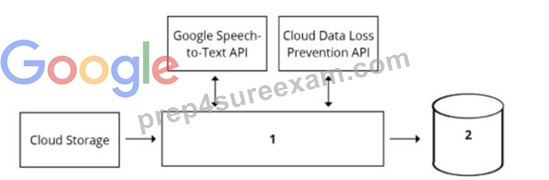
- A. 1 = Dataflow, 2 = Cloud SQL
- B. 1 = Dataflow, 2 = BigQuery
- C. 1 = Cloud Function, 2 = Cloud SQL
- D. 1 = Pub/Sub, 2 = Datastore
Answer: C
NEW QUESTION # 107
You are working on a binary classification ML algorithm that detects whether an image of a classified scanned document contains a company's logo. In the dataset, 96% of examples don't have the logo, so the dataset is very skewed. Which metrics would give you the most confidence in your model?
- A. F1 score
- B. F-score where precision is weighed more than recall
- C. F-score where recall is weighed more than precision
- D. RMSE
Answer: C
NEW QUESTION # 108
You are a data scientist at an industrial equipment manufacturing company. You are developing a regression model to estimate the power consumption in the company's manufacturing plants based on sensor data collected from all of the plants. The sensors collect tens of millions of records every day. You need to schedule daily training runs for your model that use all the data collected up to the current date. You want your model to scale smoothly and require minimal development work. What should you do?
- A. Develop a custom scikit-learn regression model, and optimize it using Vertex AI Training.
- B. Develop a regression model using BigQuery ML.
- C. Develop a custom TensorFlow regression model, and optimize it using Vertex AI Training.
- D. Train a regression model using AutoML Tables.
Answer: D
NEW QUESTION # 109
You recently developed a deep learning model using Keras, and now you are experimenting with different training strategies. First, you trained the model using a single GPU, but the training process was too slow. Next, you distributed the training across 4 GPUs using tf.distribute.MirroredStrategy (with no other changes), but you did not observe a decrease in training time. What should you do?
- A. Use a TPU with tf.distribute.TPUStrategy.
- B. Increase the batch size.
- C. Create a custom training loop.
- D. Distribute the dataset with tf.distribute.Strategy.experimental_distribute_dataset
Answer: C
Explanation:
This would allow you to tailor the training process to your specific needs and requirements, and it would also allow for more flexible experimentation with different training strategies.
Additionally, creating a custom training loop could result in faster training times compared to using a single GPU or the distributed training strategies currently available in Keras.
NEW QUESTION # 110
You are building a linear regression model on BigQuery ML to predict a customer's likelihood of purchasing your company's products. Your model uses a city name variable as a key predictive component. In order to train and serve the model, your data must be organized in columns. You want to prepare your data using the least amount of coding while maintaining the predictable variables. What should you do?
- A. Use Cloud Data Fusion to assign each city to a region labeled as 1, 2, 3, 4, or 5r and then use that number to represent the city in the model.
- B. Use TensorFlow to create a categorical variable with a vocabulary list Create the vocabulary file, and upload it as part of your model to BigQuery ML.
- C. Use Dataprep to transform the state column using a one-hot encoding method, and make each city a column with binary values.
- D. Create a new view with BigQuery that does not include a column with city information
Answer: A
NEW QUESTION # 111
......
Accurate & Verified New Professional-Machine-Learning-Engineer Answers As Experienced in the Actual Test!: https://www.prep4sureexam.com/Professional-Machine-Learning-Engineer-dumps-torrent.html
Valid Professional-Machine-Learning-Engineer Test Answers Full-length Practice Certification Exams: https://drive.google.com/open?id=1v60T1vJzYE15UQSnjCCQWHoTtZU9ywxA