

Clear your concepts with Professional-Machine-Learning-Engineer Questions Before Attempting Real exam
Get professional help from our Professional-Machine-Learning-Engineer Dumps PDF
Google Professional Machine Learning Engineer certification is highly regarded in the industry and is recognized as a benchmark for machine learning expertise. It is an ideal certification for professionals who are looking to enhance their career prospects and advance their skills in machine learning. Google Professional Machine Learning Engineer certification demonstrates that the candidate has the necessary skills to design and implement machine learning solutions that meet the requirements of modern businesses.
Google Professional Machine Learning Engineer Certification Exam is a comprehensive test that validates the expertise of individuals in the field of machine learning. Google Professional Machine Learning Engineer certification exam is designed to test the individual's ability to design, build, and deploy scalable machine learning models using Google Cloud Platform. Individuals who pass the exam will receive a certificate that is recognized by Google Cloud Platform and can be used to advance one's career in the field of machine learning.
How to Prepare For Professional Machine Learning Engineer - Google
Preparation Guide for Professional Machine Learning Engineer - Google
Introduction for Professional Machine Learning Engineer - Google
A Professional Machine Learning Engineer designs, builds, and productionizes ML models to solve business challenges using Google Cloud technologies and knowledge of proven ML models and techniques. The ML Engineer is proficient in all aspects of model architecture, data pipeline interaction, and metrics interpretation and needs familiarity with application development, infrastructure management, data engineering, and security.
The Professional Machine Learning Engineer exam assesses your ability to:
- Prepare and process data
- Architect ML solutions
- Develop ML models
We prepare Google Professional-Machine-Learning-Engineer practice exams and Google Professional-Machine-Learning-Engineer practice exams to prepare you for all these requirements.
NEW QUESTION # 36
You want to train an AutoML model to predict house prices by using a small public dataset stored in BigQuery. You need to prepare the data and want to use the simplest most efficient approach. What should you do?
- A. Use a Vertex Al Workbench notebook instance to preprocess the data by using the pandas library Export the data as CSV files, and use those files to create a Vertex Al managed dataset.
- B. Use Dataflow to preprocess the data Write the output in TFRecord format to a Cloud Storage bucket.
- C. Write a query that preprocesses the data by using BigQuery and creates a new table Create a Vertex Al managed dataset with the new table as the data source.
- D. Write a query that preprocesses the data by using BigQuery Export the query results as CSV files and use those files to create a Vertex Al managed dataset.
Answer: C
NEW QUESTION # 37
You work at a bank You have a custom tabular ML model that was provided by the bank's vendor. The training data is not available due to its sensitivity. The model is packaged as a Vertex Al Model serving container which accepts a string as input for each prediction instance. In each string the feature values are separated by commas. You want to deploy this model to production for online predictions, and monitor the feature distribution over time with minimal effort What should you do?
- A. 1 Refactor the serving container to accept key-value pairs as input format.
2 Upload the model to Vertex Al Model Registry and deploy the model to a Vertex Al endpoint.
3. Create a Vertex Al Model Monitoring job with feature skew detection as the monitoring objective. - B. 1 Refactor the serving container to accept key-value pairs as input format.
2. Upload the model to Vertex Al Model Registry and deploy the model to a Vertex Al endpoint.
3. Create a Vertex Al Model Monitoring job with feature drift detection as the monitoring objective. - C. 1 Upload the model to Vertex Al Model Registry and deploy the model to a Vertex Al endpoint.
2 Create a Vertex Al Model Monitoring job with feature skew detection as the monitoring objective and provide an instance schema. - D. 1 Upload the model to Vertex Al Model Registry and deploy the model to a Vertex Ai endpoint.
2. Create a Vertex Al Model Monitoring job with feature drift detection as the monitoring objective, and provide an instance schema.
Answer: D
Explanation:
The best option for deploying a custom tabular ML model to production for online predictions, and monitoring the feature distribution over time with minimal effort, using a model that was provided by the bank's vendor, the training data is not available due to its sensitivity, and the model is packaged as a Vertex AI Model serving container which accepts a string as input for each prediction instance, is to upload the model to Vertex AI Model Registry and deploy the model to a Vertex AI endpoint, create a Vertex AI Model Monitoring job with feature drift detection as the monitoring objective, and provide an instance schema. This option allows you to leverage the power and simplicity of Vertex AI to serve and monitor your model with minimal code and configuration. Vertex AI is a unified platform for building and deploying machine learning solutions on Google Cloud. Vertex AI can deploy a trained model to an online prediction endpoint, which can provide low-latency predictions for individual instances. Vertex AI can also provide various tools and services for data analysis, model development, model deployment, model monitoring, and model governance. A Vertex AI Model Registry is a resource that can store and manage your models on Vertex AI. A Vertex AI Model Registry can help you organize and track your models, and access various model information, such as model name, model description, and model labels. A Vertex AI Model serving container is a resource that can run your custom model code on Vertex AI. A Vertex AI Model serving container can help you package your model code and dependencies into a container image, and deploy the container image to an online prediction endpoint. A Vertex AI Model serving container can accept various input formats, such as JSON, CSV, or TFRecord. A string input format is a type of input format that accepts a string as input for each prediction instance. A string input format can help you encode your feature values into a single string, and separate them by commas. By uploading the model to Vertex AI Model Registry and deploying the model to a Vertex AI endpoint, you can serve your model for online predictions with minimal code and configuration. You can use the Vertex AI API or the gcloud command-line tool to upload the model to Vertex AI Model Registry, and provide the model name, model description, and model labels. You can also use the Vertex AI API or the gcloud command-line tool to deploy the model to a Vertex AI endpoint, and provide the endpoint name, endpoint description, endpoint labels, and endpoint resources. A Vertex AI Model Monitoring job is a resource that can monitor the performance and quality of your deployed models on Vertex AI. A Vertex AI Model Monitoring job can help you detect and diagnose issues with your models, such as data drift, prediction drift, training/serving skew, or model staleness. Feature drift is a type of model monitoring metric that measures the difference between the distributions of the features used to train the model and the features used to serve the model over time. Feature drift can indicate that the online data is changing over time, and the model performance is degrading. By creating a Vertex AI Model Monitoring job with feature drift detection as the monitoring objective, and providing an instance schema, you can monitor the feature distribution over time with minimal effort. You can use the Vertex AI API or the gcloud command-line tool to create a Vertex AI Model Monitoring job, and provide the monitoring objective, the monitoring frequency, the alerting threshold, and the notification channel. You can also provide an instance schema, which is a JSON file that describes the features and their types in the prediction input data. An instance schema can help Vertex AI Model Monitoring parse and analyze the string input format, and calculate the feature distributions and distance scores1.
The other options are not as good as option A, for the following reasons:
* Option B: Uploading the model to Vertex AI Model Registry and deploying the model to a Vertex AI endpoint, creating a Vertex AI Model Monitoring job with feature skew detection as the monitoring objective, and providing an instance schema would not help you monitor the changes in the online data over time, and could cause errors or poor performance. Feature skew is a type of model monitoring metric that measures the difference between the distributions of the features used to train the model and the features used to serve the model at a given point in time. Feature skew can indicate that the model is not trained on the representative data, or that the data is changing over time. By creating a Vertex AI Model Monitoring job with feature skew detection as the monitoring objective, and providing an instance schema, you can monitor the feature distribution at a given point in time with minimal effort.
However, uploading the model to Vertex AI Model Registry and deploying the model to a Vertex AI endpoint, creating a Vertex AI Model Monitoring job with feature skew detection as the monitoring objective, and providing an instance schema would not help you monitor the changes in the online data over time, and could cause errors or poor performance. You would need to use the Vertex AI API or the gcloud command-line tool to upload the model to Vertex AI Model Registry, deploy the model to a Vertex AI endpoint, create a Vertex AI Model Monitoring job, and provide an instance schema. Moreover, this option would not monitor the feature drift, which is a more direct and relevant metric for measuring the changes in the online data over time, and the model performance and quality1.
* Option C: Refactoring the serving container to accept key-value pairs as input format, uploading the model to Vertex AI Model Registry and deploying the model to a Vertex AI endpoint, creating a Vertex AI Model Monitoring job with feature drift detection as the monitoring objective would require more skills and steps than uploading the model to Vertex AI Model Registry and deploying the model to a Vertex AI endpoint, creating a Vertex AI Model Monitoring job with feature drift detection as the monitoring objective, and providing an instance schema. A key-value pair input format is a type of input format that accepts a key-value pair as input for each prediction instance. A key-value pair input format can help you specify the feature names and values in a JSON object, and separate them by colons. By refactoring the serving container to accept key-value pairs as input format, uploading the model to Vertex AI Model Registry and deploying the model to a Vertex AI endpoint, creating a Vertex AI Model Monitoring job with feature drift detection as the monitoring objective, you can serve and
* monitor your model with minimal code and configuration. You can write code to refactor the serving container to accept key-value pairs as input format, anduse the Vertex AI API or the gcloud command-line tool to upload the model to Vertex AI Model Registry, deploy the model to a Vertex AI endpoint, and create a Vertex AI Model Monitoring job. However, refactoring the serving container to accept key-value pairs as input format, uploading the model to Vertex AI Model Registry and deploying the model to a Vertex AI endpoint, creating a Vertex AI Model Monitoring job with feature drift detection as the monitoring objective would require more skills and steps than uploading the model to Vertex AI Model Registry and deploying the model to a Vertex AI endpoint, creating a Vertex AI Model Monitoring job with feature drift detection as the monitoring objective, and providing an instance schema. You would need to write code, refactor the serving container, upload the model to Vertex AI Model Registry, deploy the model to a Vertex AI endpoint, and create a Vertex AI Model Monitoring job. Moreover, this option would not use the instance schema, which is a JSON file that can help Vertex AI Model Monitoring parse and analyze the string input format, and calculate the feature distributions and distance scores1.
* Option D: Refactoring the serving container to accept key-value pairs as input format, uploading the model to Vertex AI Model Registry and deploying the model to a Vertex AI endpoint, creating a Vertex AI Model Monitoring job with feature skew detection as the monitoring objective would require more skills and steps than uploading the model to Vertex AI Model Registry and deploying the model to a Vertex AI endpoint, creating a Vertex AI Model Monitoring job with feature drift detection as the monitoring objective, and providing an instance schema, and would not help you monitor the changes in the online data over time, and could cause errors or poor performance. Feature skew is a type of model monitoring metric that measures the difference between the distributions of the features used to train the model and the features used to serve the model at a given point in time. Feature skew can indicate that the model is not trained on the representative data, or that the data is changing over time. By creating a Vertex AI Model Monitoring job with feature skew detection as the monitoring objective, you can monitor the feature distribution at a given point in time with minimal effort. However, refactoring the serving container to accept key-value pairs as input format, uploading the model to Vertex AI Model Registry and deploying the model to a Vertex AI endpoint, creating a Vertex AI Model Monitoring job with feature skew detection as the monitoring objective would require more skills and steps than uploading the model to Vertex AI Model Registry and deploying the model to a Vertex AI endpoint, creating a Vertex AI Model Monitoring job with feature drift detection as the monitoring objective, and providing an instance schema, and would not help you monitor the changes in the online data over time, and could cause errors or poor performance. You would need to write code, refactor the serving container, upload the model to Vertex AI Model Registry, deploy the model to a Vertex AI endpoint, and create a Vertex AI Model Monitoring job. Moreover, this option would not monitor the feature drift, which is a more direct and relevant metric formeasuring the changes in the online data over time, and the model performance and quality1.
References:
* Using Model Monitoring | Vertex AI | Google Cloud
NEW QUESTION # 38
You were asked to investigate failures of a production line component based on sensor readings. After receiving the dataset, you discover that less than 1% of the readings are positive examples representing failure incidents. You have tried to train several classification models, but none of them converge. How should you resolve the class imbalance problem?
- A. Downsample the data with upweighting to create a sample with 10% positive examples
- B. Use a convolutional neural network with max pooling and softmax activation
- C. Remove negative examples until the numbers of positive and negative examples are equal
- D. Use the class distribution to generate 10% positive examples
Answer: A
Explanation:
The class imbalance problem is a common challenge in machine learning, especially in classification tasks. It occurs when the distribution of the target classes is highly skewed, such that one class (the majority class) has much more examples than the other class (the minority class). The minority class is often the more interesting or important class, such as failure incidents, fraud cases, or rare diseases. However, most machine learning algorithms are designed to optimize the overall accuracy, which can be biased towards the majority class and ignore the minority class. This can result in poor predictive performance, especially for the minority class.
There are different techniques to deal with the class imbalance problem, such as data-level methods, algorithm-level methods, and evaluation-level methods1. Data-level methods involve resampling the original dataset to create a more balanced class distribution. There are two main types of data-level methods:
oversampling and undersampling. Oversampling methods increase the number of examples in the minority class, either by duplicating existing examples or by generating synthetic examples. Undersampling methods reduce the number of examples in the majority class, either by randomly removing examples or by using clustering or other criteria to select representative examples. Both oversampling and undersampling methods can be combined with upweighting or downweighting, which assign different weights to the examples according to their class frequency, to further balance the dataset.
For the use case of investigating failures of a production line component based on sensor readings, the best option is to downsample the data with upweighting to create a sample with 10% positive examples. This option involves randomly removing some of the negative examples (the majority class) until the ratio of positive to negative examples is 1:9, and then assigning higher weights to the positive examples to compensate for their low frequency. This option can create a more balanced dataset that can improve the performance of the classification models, while preserving the diversity and representativeness of the original data. This option can also reduce the computation time and memory usage, as the size of the dataset is reduced.
Therefore, downsampling the data with upweighting to create a sample with 10% positive examples is the best option for this use case.
References:
* A Systematic Study of the Class Imbalance Problem in Convolutional Neural Networks
NEW QUESTION # 39
You are collaborating on a model prototype with your team. You need to create a Vertex Al Workbench environment for the members of your team and also limit access to other employees in your project. What should you do?
- A. 1. Create a new service account and grant it the Notebook Viewer role.
2 Grant the Service Account User role to each team member on the service account.
3 Grant the Vertex Al User role to each team member.
4. Provision a Vertex Al Workbench user-managed notebook instance that uses the new service account. - B. 1. Grant the Vertex Al User role to the default Compute Engine service account.
2. Grant the Service Account User role to each team member on the default Compute Engine service account.
3. Provision a Vertex Al Workbench user-managed notebook instance that uses the default Compute Engine service account. - C. 1 Create a new service account and grant it the Vertex Al User role.
2 Grant the Service Account User role to each team member on the service account.
3. Grant the Notebook Viewer role to each team member.
4 Provision a Vertex Al Workbench user-managed notebook instance that uses the new service account. - D. 1 Grant the Vertex Al User role to the primary team member.
2. Grant the Notebook Viewer role to the other team members.
3. Provision a Vertex Al Workbench user-managed notebook instance that uses the primary user's account.
Answer: C
Explanation:
To create a Vertex AI Workbench environment for your team and limit access to other employees in your project, you should follow these steps:
* Create a new service account and grant it the Vertex AI User role. This role grants full access to all resources in Vertex AI, including creating and managing notebook instances1.
* Grant the Service Account User role to each team member on the service account. This role allows the team members to impersonate the service account and use its permissions2.
* Grant the Notebook Viewer role to each team member. This role allows the team members to view and connect to the notebook instance, but not to modify or delete it3.
* Provision a Vertex AI Workbench user-managed notebook instance that uses the new service account.
This way, the notebook instance will run as the service account and only the team members who have the Service Account User and Notebook Viewer roles will be able to access it.
References:
* 1: Vertex AI access control with IAM | Google Cloud
* 2: Understanding service accounts | Cloud IAM Documentation
* 3: Manage access to a Vertex AI Workbench instance | Google Cloud
* [4]: Create and manage Vertex AI Workbench instances | Google Cloud
NEW QUESTION # 40
You work as an analyst at a large banking firm. You are developing a robust, scalable ML pipeline to train several regression and classification models. Your primary focus for the pipeline is model interpretability. You want to productionize the pipeline as quickly as possible What should you do?
- A. Use Tabular Workflow for Wide & Deep through Vertex Al Pipelines to jointly train wide linear models and deep neural networks.
- B. Use Google Kubernetes Engine to build a custom training pipeline for XGBoost-based models.
- C. Use Cloud Composer to build the training pipelines for custom deep learning-based models.
- D. Use Tabular Workflow forTabel through Vertex Al Pipelines to train attention-based models.
Answer: C
Explanation:
According to the official exam guide1, one of the skills assessed in the exam is to "automate and orchestrate ML pipelines using Cloud Composer". Cloud Composer2 is a fully managed workflow orchestration service that uses Apache Airflow to create, schedule, monitor, and manage workflows.Cloud Composer allows you to build custom training pipelines for deep learning-based models and integrate them with other Google Cloud services. You can also use Cloud Composer to implement model interpretability techniques, such as feature attributions, explainable AI, or model debugging3. The other options are not relevant or optimal for this scenario. References:
* Professional ML Engineer Exam Guide
* Cloud Composer
* Model interpretability with Cloud Composer
* Google Professional Machine Learning Certification Exam 2023
* Latest Google Professional Machine Learning Engineer Actual Free Exam Questions
NEW QUESTION # 41
You recently joined an enterprise-scale company that has thousands of datasets. You know that there are accurate descriptions for each table in BigQuery, and you are searching for the proper BigQuery table to use for a model you are building on AI Platform. How should you find the data that you need?
- A. Use Data Catalog to search the BigQuery datasets by using keywords in the table description.
- B. Tag each of your model and version resources on AI Platform with the name of the BigQuery table that was used for training.
- C. Maintain a lookup table in BigQuery that maps the table descriptions to the table ID. Query the lookup table to find the correct table ID for the data that you need.
- D. Execute a query in BigQuery to retrieve all the existing table names in your project using the INFORMATION_SCHEMA metadata tables that are native to BigQuery. Use the result o find the table that you need.
Answer: B
NEW QUESTION # 42
You work for a retailer that sells clothes to customers around the world. You have been tasked with ensuring that ML models are built in a secure manner. Specifically, you need to protect sensitive customer data that might be used in the models. You have identified four fields containing sensitive data that are being used by your data science team: AGE, IS_EXISTING_CUSTOMER, LATITUDE_LONGITUDE, and SHIRT_SIZE.
What should you do with the data before it is made available to the data science team for training purposes?
- A. Remove all sensitive data fields, and ask the data science team to build their models using non-sensitive data.
- B. Coarsen the data by putting AGE into quantiles and rounding LATITUDE_LONGTTUDE into single precision. The other two fields are already as coarse as possible.
- C. Tokenize all of the fields using hashed dummy values to replace the real values.
- D. Use principal component analysis (PCA) to reduce the four sensitive fields to one PCA vector.
Answer: B
Explanation:
The best option for protecting sensitive customer data that might be used in the ML models is to coarsen the data by putting AGE into quantiles and rounding LATITUDE_LONGITUDE into single precision. This option has the following advantages:
* It preserves the utility and relevance of the data for the ML models, as the coarsened data still captures the essential information and patterns that the models need to learn. For example, putting AGE into quantiles can group the customers into different age ranges, which can be useful for predicting their preferences or behavior. Rounding LATITUDE_LONGITUDE into single precision can reduce the precision of the location data, but still retain the general geographic region of the customers, which can be useful for personalizing the recommendations or offers.
* It reduces the risk of exposing the personal or private information of the customers, as the coarsened data makes it harder to identify or re-identify the individual customers from the data. For example, putting AGE into quantiles can hide the exact age of the customers, which can be considered sensitive or confidential. Rounding LATITUDE_LONGITUDE into single precision can obscure the exact location of the customers, which can be considered sensitive or confidential.
The other options are less optimal for the following reasons:
* Option A: Tokenizing all of the fields using hashed dummy values to replace the real values eliminates
* the utility and relevance of the data for the ML models, as the tokenized data loses all the information and patterns that the models need to learn. For example, tokenizing AGE using hashed dummy values can make the data meaningless and irrelevant, as the models cannot learn anything from the random tokens. Tokenizing LATITUDE_LONGITUDE using hashed dummy values can make the data meaningless and irrelevant, as the models cannot learn anything from the random tokens.
* Option B: Using principal component analysis (PCA) to reduce the four sensitive fields to one PCA vector reduces the utility and relevance of the data for the ML models, as the PCA vector may not capture all the information and patterns that the models need to learn. For example, using PCA to reduce AGE, IS_EXISTING_CUSTOMER, LATITUDE_LONGITUDE, and SHIRT_SIZE to one PCA vector can lose some information or introduce noise in the data, as the PCA vector is a linear combination of the original features, which may not reflect their true relationship or importance. Moreover, using PCA to reduce the four sensitive fields to one PCA vector may not reduce the risk of exposing the personal or private information of the customers, as the PCA vector may still be reversible or linkable to the original data, depending on the amount of variance explained by the PCA vector and the availability of the PCA transformation matrix.
* Option D: Removing all sensitive data fields, and asking the data science team to build their models using non-sensitive data reduces the utility and relevance of the data for the ML models, as the non-sensitive data may not contain enough information and patterns that the models need to learn. For example, removing AGE, IS_EXISTING_CUSTOMER, LATITUDE_LONGITUDE, and SHIRT_SIZE from the data can make the data insufficient and unrepresentative, as the models may not be able to learn the factors that influence the customers' preferences or behavior. Moreover, removing all sensitive data fields from the data may not be necessary or feasible, as the data protection legislation may allow the use of sensitive data for the ML models, as long as the data is processed in a secure and ethical manner, and the customers' consent and rights are respected.
References:
* Protecting Sensitive Data and AI Models with Confidential Computing | NVIDIA Technical Blog
* Training machine learning models from sensitive data | Fast Data Science
* Securing ML applications. Model security and protection - Medium
* Security of AI/ML systems, ML model security | Cossack Labs
* Vulnerabilities, security and privacy for machine learning models
NEW QUESTION # 43
You are training a Resnet model on Al Platform using TPUs to visually categorize types of defects in automobile engines. You capture the training profile using the Cloud TPU profiler plugin and observe that it is highly input-bound. You want to reduce the bottleneck and speed up your model training process. Which modifications should you make to the tf .data dataset?
Choose 2 answers
- A. Reduce the value of the repeat parameter
- B. Use the interleave option for reading data
- C. Decrease the batch size argument in your transformation
- D. Increase the buffer size for the shuffle option.
- E. Set the prefetch option equal to the training batch size
Answer: B,E
Explanation:
The tf.data dataset is a TensorFlow API that provides a way to create and manipulate data pipelines for machine learning. The tf.data dataset allows you to apply various transformations to the data, such as reading, shuffling, batching, prefetching, and interleaving. These transformations can affect the performance and efficiency of the model training process1 One of the common performance issues in model training is input-bound, which means that the model is waiting for the input data to be ready and is not fully utilizing the computational resources. Input-bound can be caused by slow data loading, insufficient parallelism, or large data size. Input-bound can be detected by using the Cloud TPU profiler plugin, which is a tool that helps you analyze the performance of your model on Cloud TPUs. The Cloud TPU profiler plugin can show you the percentage of time that the TPU cores are idle, which indicates input-bound2 To reduce the input-bound bottleneck and speed up the model training process, you can make some modifications to the tf.data dataset. Two of the modifications that can help are:
* Use the interleave option for reading data. The interleave option allows you to read data from multiple files in parallel and interleave their records. This can improve the data loading speed and reduce the idle time of the TPU cores. The interleave option can be applied by using the tf.data.Dataset.interleave method, which takes a function that returns a dataset for each input element, and a number of parallel calls3
* Set the prefetch option equal to the training batch size. The prefetch option allows you to prefetch the next batch of data while the current batch is being processed by the model. This can reduce the latency between batches and improve the throughput of the model training.The prefetch option can be applied by using the tf.data.Dataset.prefetch method, which takes a buffer size argument. The buffer size should be equal to the training batch size, which is the number of examples per batch4 The other options are not effective or counterproductive. Reducing the value of the repeat parameter will reduce the number of epochs, which is the number of times the model sees the entire dataset. This can affect the model's accuracy and convergence. Increasing the buffer size for the shuffle option will increase the randomness of the data, but also increase the memory usage and the data loading time. Decreasing the batch size argument in your transformation will reduce the number of examples per batch, which can affect the model's stability and performance.
References: 1: tf.data: Build TensorFlow input pipelines 2: Cloud TPU Tools in TensorBoard 3: tf.data.Dataset.interleave 4: tf.data.Dataset.prefetch : [Better performance with the tf.data API]
NEW QUESTION # 44
You work at an ecommerce startup. You need to create a customer churn prediction model Your company's recent sales records are stored in a BigQuery table You want to understand how your initial model is making predictions. You also want to iterate on the model as quickly as possible while minimizing cost How should you build your first model?
- A. Export the data to a Cloud Storage Bucket Load the data into a pandas DataFrame on Vertex Al Workbench and train a logistic regression model with scikit-learn.
- B. Create a tf.data.Dataset by using the TensorFlow BigQueryChent Implement a deep neural network in TensorFlow.
- C. Prepare the data in BigQuery and associate the data with a Vertex Al dataset Create an AutoMLTabuiarTrainmgJob to train a classification model.
- D. Export the data to a Cloud Storage Bucket Create tf. data. Dataset to read the data from Cloud Storage Implement a deep neural network in TensorFlow.
Answer: C
NEW QUESTION # 45
You work for a hospital that wants to optimize how it schedules operations. You need to create a model that uses the relationship between the number of surgeries scheduled and beds used You want to predict how many beds will be needed for patients each day in advance based on the scheduled surgeries You have one year of data for the hospital organized in 365 rows The data includes the following variables for each day
* Number of scheduled surgeries
* Number of beds occupied
* Date
You want to maximize the speed of model development and testing What should you do?
- A. Create a Vertex Al tabular dataset Train a Vertex Al AutoML Forecasting model with number of beds as the
- B. Create a BigQuery table Use BigQuery ML to build a regression model, with number of beds as the target variable and number of scheduled surgeries and date features (such as day of week) as the predictors
- C. Create a BigQuery table Use BigQuery ML to build an ARIMA model, with number of beds as the target variable and date as the time variable.
- D. Create a Vertex Al tabular dataset Tram an AutoML regression model, with number of beds as the target variable and number of scheduled minor surgeries and date features (such as day of the week) as the predictors
Answer: A
Explanation:
target variable, number of scheduled surgeries as a covariate, and date as the time variable.
NEW QUESTION # 46
You have created a Vertex Al pipeline that includes two steps. The first step preprocesses 10 TB data completes in about 1 hour, and saves the result in a Cloud Storage bucket The second step uses the processed data to train a model You need to update the model's code to allow you to test different algorithms You want to reduce pipeline execution time and cost, while also minimizing pipeline changes What should you do?
- A. Configure a machine with more CPU and RAM from the compute-optimized machine family for the data preprocessing step.
- B. Add a pipeline parameter and an additional pipeline step Depending on the parameter value the pipeline step conducts or skips data preprocessing and starts model training.
- C. Enable caching for the pipeline job. and disable caching for the model training step.
- D. Create another pipeline without the preprocessing step, and hardcode the preprocessed Cloud Storage file location for model training.
Answer: C
Explanation:
The best option for reducing pipeline execution time and cost, while also minimizing pipeline changes, is to enable caching for the pipeline job, and disable caching for the model training step. This option allows you to leverage the power and simplicity of Vertex AI Pipelines to reuse the output of the data preprocessing step, and avoid unnecessary recomputation. Vertex AI Pipelines is a service that can orchestrate machine learning workflows using Vertex AI. Vertex AI Pipelines can run preprocessing and training steps on custom Docker images, and evaluate, deploy, and monitor themachine learning model. Caching is a feature of Vertex AI Pipelines that can store and reuse the output of a pipeline step, and skip the execution of the step if the input parameters and the code have not changed. Caching can help you reduce the pipeline execution time and cost, as you do not need to re-run the same step with the same input and code. Caching can also help you minimize the pipeline changes, as you do not need to add or remove any pipeline steps or parameters. By enabling caching for the pipeline job, and disabling caching for the model training step, you can create a Vertex AI pipeline that includes two steps. The first step preprocesses 10 TB data, completes in about 1 hour, and saves the result in a Cloud Storage bucket. The second step uses the processed data to train a model. You can update the model's code to allow you to test different algorithms, and run the pipeline job with caching enabled. The pipeline job will reuse the output of the data preprocessing step from the cache, and skip the execution of the step. The pipeline job will run the model training step with the updated code, and disable the caching for the step. This way, you can reduce the pipeline execution time and cost, while also minimizing pipeline changes1.
The other options are not as good as option D, for the following reasons:
* Option A: Adding a pipeline parameter and an additional pipeline step, depending on the parameter value, the pipeline step conducts or skips data preprocessing and starts model training, would require more skills and steps than enabling caching for the pipeline job, and disabling caching for the model training step. A pipeline parameter is a variable that can be used to control the input or output of a pipeline step. A pipeline parameter can help you customize the pipeline logic and behavior, and experiment with different values. An additional pipeline step is a new instance of a pipeline component that can perform a part of the pipeline workflow, such as data preprocessing or model training. An additional pipeline step can help you extend the pipeline functionality and complexity, and handle
* different scenarios. However, adding a pipeline parameter and an additional pipeline step, depending on the parameter value, the pipeline step conducts or skips data preprocessing and starts model training, would require more skills and steps than enabling caching for the pipeline job, and disabling caching for the model training step. You would need to write code, define the pipeline parameter, create the additional pipeline step, implement the conditional logic, and compile and run the pipeline. Moreover, this option would not reuse the output of the data preprocessing step from the cache, but rather from the Cloud Storage bucket, which can increase the data transfer and access costs1.
* Option B: Creating another pipeline without the preprocessing step, and hardcoding the preprocessed Cloud Storage file location for model training, would require more skills and steps than enabling caching for the pipeline job, and disabling caching for the model training step. A pipeline without the preprocessing step is a pipeline that only includes the model training step, and uses the preprocessed data from the Cloud Storage bucket as the input. A pipeline without the preprocessing step can help you avoid running the data preprocessing step every time, and reduce the pipeline execution time and cost.
However, creating another pipeline without the preprocessing step, and hardcoding the preprocessed Cloud Storage file location for model training, would require more skills and steps than enabling caching for the pipeline job, and disabling caching for the model training step. You would need to write code, create a new pipeline, remove the preprocessing step, hardcode the Cloud Storage file location, and compile and run the pipeline. Moreover, this option would not reuse the output of the data preprocessing step from the cache, but rather from the Cloud Storage bucket,which can increase the data transfer and access costs. Furthermore, this option would create another pipeline, which can increase the maintenance and management costs1.
* Option C: Configuring a machine with more CPU and RAM from the compute-optimized machine family for the data preprocessing step, would not reduce the pipeline execution time and cost, while also minimizing pipeline changes, but rather increase the pipeline execution cost and complexity. A machine with more CPU and RAM from the compute-optimized machine family is a virtual machine that has a high ratio of CPU cores to memory, and can provide high performance and scalability for compute-intensive workloads. A machine with more CPU and RAM from the compute-optimized machine family can help you optimize the data preprocessing step, and reduce the pipeline execution time. However, configuring a machine with more CPU and RAM from the compute-optimized machine family for the data preprocessing step, would not reduce the pipeline execution time and cost, while also minimizing pipeline changes, but rather increase the pipeline execution cost and complexity. You would need to write code, configure the machine type parameters for the data preprocessing step, and compile and run the pipeline. Moreover, this option would increase the pipeline execution cost, as machines with more CPU and RAM from the compute-optimized machine family are more expensive than machines with less CPU and RAM from other machine families. Furthermore, this option would not reuse the output of the data preprocessing step from the cache, but rather re-run the data preprocessing step every time, which can increase the pipeline execution time and cost1.
References:
* Preparing for Google Cloud Certification: Machine Learning Engineer, Course 3: Production ML Systems, Week 3: MLOps
* Google Cloud Professional Machine Learning Engineer Exam Guide, Section 3: Scaling ML models in production, 3.2 Automating ML workflows
* Official Google Cloud Certified Professional Machine Learning Engineer Study Guide, Chapter 6:
Production ML Systems, Section 6.4: Automating ML Workflows
* Vertex AI Pipelines
* Caching
* Pipeline parameters
* Machine types
NEW QUESTION # 47
A Machine Learning Specialist is packaging a custom ResNet model into a Docker container so the company can leverage Amazon SageMaker for training. The Specialist is using Amazon EC2 P3 instances to train the model and needs to properly configure the Docker container to leverage the NVIDIA GPUs.
What does the Specialist need to do?
- A. Bundle the NVIDIA drivers with the Docker image.
- B. Organize the Docker container's file structure to execute on GPU instances.
- C. Set the GPU flag in the Amazon SageMaker CreateTrainingJob request body.
- D. Build the Docker container to be NVIDIA-Docker compatible.
Answer: A
NEW QUESTION # 48
You work on a data science team at a bank and are creating an ML model to predict loan default risk. You have collected and cleaned hundreds of millions of records worth of training data in a BigQuery table, and you now want to develop and compare multiple models on this data using TensorFlow and Vertex AI. You want to minimize any bottlenecks during the data ingestion state while considering scalability. What should you do?
- A. Export data to CSV files in Cloud Storage, and use tf.data.TextLineDataset() to read them.
- B. Use the BigQuery client library to load data into a dataframe, and use tf.data.Dataset.from_tensor_slices() to read it.
- C. Convert the data into TFRecords, and use tf.data.TFRecordDataset() to read them.
- D. Use TensorFlow I/O's BigQuery Reader to directly read the data.
Answer: D
Explanation:
TensorFlow I/O's BigQuery Reader allows you to directly read data from BigQuery tables into your TensorFlow model without the need to export the data to a separate file format. This can minimize any bottlenecks during the data ingestion stage and also it can increase the scalability. By using BigQuery Reader, you can easily read large amounts of data from BigQuery and use it to train your model without having to worry about the performance impact of reading from a dataframe or CSV file.
You can use the tfio.BigQueryRecordDataset which will return a dataset of dictionaries, and where each key corresponds to a table column and each value corresponds to the value in that column.
NEW QUESTION # 49
You work at an organization that maintains a cloud-based communication platform that integrates conventional chat, voice, and video conferencing into one platform. The audio recordings are stored in Cloud Storage. All recordings have an 8 kHz sample rate and are more than one minute long. You need to implement a new feature in the platform that will automatically transcribe voice call recordings into a text for future applications, such as call summarization and sentiment analysis. How should you implement the voice call transcription feature following Google-recommended best practices?
- A. Use the original audio sampling rate, and transcribe the audio by using the Speech-to-Text API with asynchronous recognition.
- B. Upsample the audio recordings to 16 kHz. and transcribe the audio by using the Speech-to-Text API with synchronous recognition.
- C. Upsample the audio recordings to 16 kHz. and transcribe the audio by using the Speech-to-Text API with asynchronous recognition.
- D. Use the original audio sampling rate, and transcribe the audio by using the Speech-to-Text API with synchronous recognition.
Answer: C
NEW QUESTION # 50
You are training a Resnet model on Al Platform using TPUs to visually categorize types of defects in automobile engines. You capture the training profile using the Cloud TPU profiler plugin and observe that it is highly input-bound. You want to reduce the bottleneck and speed up your model training process. Which modifications should you make to the tf .data dataset?
Choose 2 answers
- A. Reduce the value of the repeat parameter
- B. Use the interleave option for reading data
- C. Decrease the batch size argument in your transformation
- D. Increase the buffer size for the shuffle option.
- E. Set the prefetch option equal to the training batch size
Answer: B,E
NEW QUESTION # 51
You have recently developed a custom model for image classification by using a neural network. You need to automatically identify the values for learning rate, number of layers, and kernel size. To do this, you plan to run multiple jobs in parallel to identify the parameters that optimize performance. You want to minimize custom code development and infrastructure management. What should you do?
- A. Create a custom training job that uses the Vertex Al Vizier SDK for parameter optimization.
- B. Create a Vertex Al hyperparameter tuning job.
- C. Train an AutoML image classification model.
- D. Create a Vertex Al pipeline that runs different model training jobs in parallel.
Answer: B
NEW QUESTION # 52
You work for a social media company. You need to detect whether posted images contain cars. Each training example is a member of exactly one class. You have trained an object detection neural network and deployed the model version to Al Platform Prediction for evaluation. Before deployment, you created an evaluation job and attached it to the Al Platform Prediction model version. You notice that the precision is lower than your business requirements allow. How should you adjust the model's final layer softmax threshold to increase precision?
- A. Increase the number of false positives
- B. Decrease the number of false negatives
- C. Increase the recall
- D. Decrease the recall.
Answer: D
Explanation:
Precision and recall are two common metrics for evaluating the performance of a classification model.
Precision measures the proportion of positive predictions that are correct, while recall measures the proportion of positive examples that are correctly predicted. Precision and recall are inversely related, meaning that increasing one will decrease the other, and vice versa. The trade-off between precision and recall depends on the goal and the cost of the classification problem1.
For the use case of detecting whether posted images contain cars, precision is more important than recall, as the social media company wants to minimize the number of false positives, or images that are incorrectly labeled as containing cars. A high precision means that the model is confident and accurate in its positive predictions, while a low recall means that the model may miss some positive examples, or images that actually contain cars. The cost of missing some positive examples is lower than the cost of making wrong positive predictions, as the latter may affect the user experience and the reputation of the social media company.
The softmax function is a function that transforms a vector of real numbers into a probability distribution over the possible classes. The softmax function is often used as the final layer of a neural network for multi-class classification problems, as it assigns a probability to each class, and the class with the highest probability is chosen as the prediction. The softmax function is defined as:
softmax (x_i) = exp (x_i) / sum_j exp (x_j)
where x_i is the input value for class i, and softmax (x_i) is the output probability for class i.
The softmax threshold is a parameter that determines the minimum probability that a class must have to be chosen as the prediction. For example, if the softmax threshold is 0.5, then the class with the highest probability must have at least 0.5 to be selected, otherwise the prediction is none. The softmax threshold can be used to adjust the trade-off between precision and recall, as a higher threshold will increase the precision and decrease the recall, while a lower threshold will decrease the precision and increase the recall2.
For the use case of detecting whether posted images contain cars, the best way to adjust the model's final layer softmax threshold to increase precision is to decrease the recall. This means that the softmax threshold should be increased, so that the model will only make positive predictions when it is highly confident, and avoid making false positives. By increasing the softmax threshold, the model will become more selective and accurate in its positive predictions, and improve the precision metric. Therefore, decreasing the recall is the best option for this use case.
References:
* Precision and recall - Wikipedia
* How to add a threshold in softmax scores - Stack Overflow
NEW QUESTION # 53
You are training an ML model on a large dataset. You are using a TPU to accelerate the training process You notice that the training process is taking longer than expected. You discover that the TPU is not reaching its full capacity. What should you do?
- A. Increase the learning rate
- B. Increase the number of epochs
- C. Decrease the learning rate
- D. Increase the batch size
Answer: D
Explanation:
The best option for training an ML model on a large dataset, using a TPU to accelerate the training process, and discovering that the TPU is not reaching its full capacity, is to increase the batch size. This option allows you to leverage the power and simplicity of TPUs to train your model faster and more efficiently. A TPU is a custom-developed application-specific integrated circuit (ASIC) that can accelerate machine learning workloads. A TPU can provide high performance and scalability for various types of models, such as linear regression, logistic regression, k-means clustering, matrix factorization, and deep neural networks. A TPU can also support various tools and frameworks, such as TensorFlow, PyTorch, and JAX. A batch size is a parameter that specifies the number of training examples in one forward/backward pass. A batch size can affect the speed and accuracy of the training process. A larger batch size can help you utilize the parallel processing power of the TPU, and reduce the communication overhead between the TPU and the host CPU. A larger batch size can also help you avoid overfitting, as it can reduce the variance of the gradient updates. By increasing the batch size, you can train your model on a large dataset faster and more efficiently, and make full use of the TPU capacity1.
The other options are not as good as option D, for the following reasons:
* Option A: Increasing the learning rate would not help you utilize the parallel processing power of the TPU, and could cause errors or poor performance. A learning rate is a parameter that controls how much the model is updated in each iteration. A learning rate can affect the speed and accuracy of the training process. A larger learning rate can help you converge faster, but it can also cause instability, divergence, or oscillation. By increasing the learning rate, you may not be able to find the optimal solution, and your model may perform poorly on the validation or test data2.
* Option B: Increasing the number of epochs would not help you utilize the parallel processing power of the TPU, and could increase the complexity and cost of the training process. An epoch is a measure of the number of times all of the training examples are used once in the training process. An epoch can affect the speed and accuracy of the training process. A larger number of epochs can help you learn
* more from the data, but it can also cause overfitting, underfitting, or diminishing returns. By increasing the number of epochs, you may not be able to improve the model performance significantly, and your training process may take longer and consume more resources3.
* Option C: Decreasing the learning rate would not help you utilize the parallel processing power of the TPU, and could slow down the training process. A learning rate is a parameter that controls how much the model is updated in each iteration. A learning rate can affect the speed and accuracy of the training process. A smaller learning rate can help you find a more precise solution, but it can also cause slow convergence or local minima. By decreasing the learning rate, you may not be able to reach the optimal solution in a reasonable time, and your training process may take longer2.
References:
* Preparing for Google Cloud Certification: Machine Learning Engineer, Course 2: ML Models and Architectures, Week 1: Introduction to ML Models and Architectures
* Google Cloud Professional Machine Learning Engineer Exam Guide, Section 2: Architecting ML solutions, 2.1 Designing ML models
* Official Google Cloud Certified Professional Machine Learning Engineer Study Guide, Chapter 4: ML Models and Architectures, Section 4.1: Designing ML Models
* Use TPUs
* Triose phosphate utilization and beyond: from photosynthesis to end ...
* Cloud TPU performance guide
* Google TPU: Architecture and Performance Best Practices - Run
NEW QUESTION # 54
You are training an object detection model using a Cloud TPU v2. Training time is taking longer than expected. Based on this simplified trace obtained with a Cloud TPU profile, what action should you take to decrease training time in a cost-efficient way?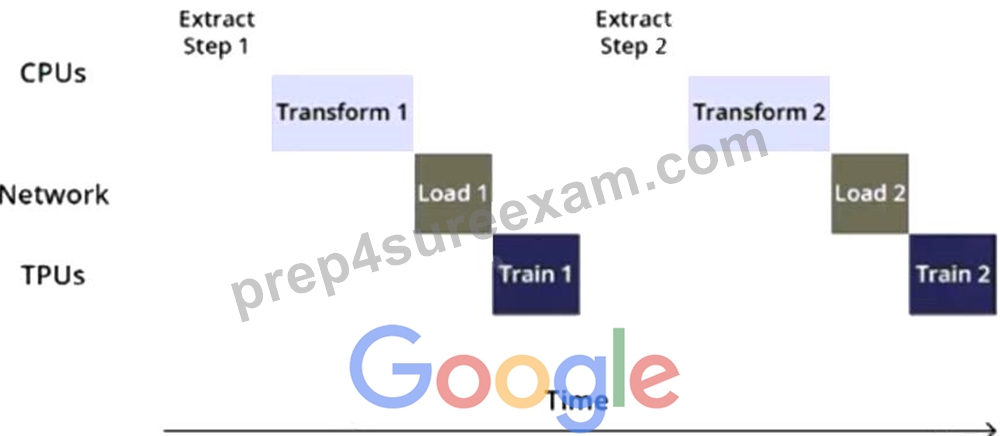
- A. Rewrite your input function using parallel reads, parallel processing, and prefetch.
- B. Rewrite your input function to resize and reshape the input images.
- C. Move from Cloud TPU v2 to Cloud TPU v3 and increase batch size.
- D. Move from Cloud TPU v2 to 8 NVIDIA V100 GPUs and increase batch size.
Answer: C
NEW QUESTION # 55
......
Achieve the Professional-Machine-Learning-Engineer Exam Best Results with Help from Google Certified Experts: https://www.prep4sureexam.com/Professional-Machine-Learning-Engineer-dumps-torrent.html
Give You Free Regular Updates on Professional-Machine-Learning-Engineer Exam Questions: https://drive.google.com/open?id=18JqEfdIEXsExCAnn4tA6QD7Fb9tcMauc