

Ace CIPS L4M5 Certification with Actual Questions Jun 15, 2026 Updated
2026 The Most Effective L4M5 with 387 Questions Answers
The Chartered Institute of Procurement and Supply (CIPS) is a globally recognized professional body that provides training and certification programs for procurement and supply chain management professionals. One such certification program is the CIPS L4M5 (Commercial Negotiation) Certification Exam, which is designed to assess the negotiation skills of procurement professionals.
CIPS L4M5 (Commercial Negotiation) Certification Exam is designed for procurement and supply chain professionals who want to specialize in commercial negotiation. L4M5 exam is based on the latest industry practices and standards and is recognized worldwide as a mark of excellence in the procurement profession. Commercial Negotiation certification is ideal for individuals who want to advance their career in procurement and supply chain management and gain a competitive edge in the job market.
NEW QUESTION # 139
To buying organisation, savings can be achieved from different saving levers or tactics. Which of the following are means that deliver savings through optimising specifications?
- A. Budget linkages
- B. Value engineering
- C. Compare total cost of ownership
- D. Volume pooling
- E. Part substitution
Answer: B,E
Explanation:
If driving greater value and efficiency from your supply base is your end, you should remember that there are many ways to do this without seeking to negotiate lower prices. Below are 7 types of saving levers:
NEW QUESTION # 140
Different types of relationships impact on commercial negotiations. At a negotiation, which one of the following sources would help to support leverage for the buyer?
- A. Powerful colleagues
- B. Friends power
- C. Legitimate power
- D. Personality power
Answer: C
NEW QUESTION # 141
Citywide Developments Ltd (CDL) is a construction programme management company that delivers the design and build of high-value property development schemes. CDL uses third-party consultant design services, using named consultants in the contract. CDL has recently observed increases in the consultancy day rate for these consultants. Which of the following tradeable concessions could CDL offer when negotiating with the suppliers of design services, in order to achieve lower rates of pay, but without lowering the quality of service?
- A. Offer a shorter consultant working day
- B. Reduce the volume-based rate discounts
- C. Remove the requirement for the named personnel
- D. Accept unqualified trainee consultants
Answer: C
Explanation:
Reference: CIPS L4M5 Study Guide, Section 3.2 - The Negotiation Process
NEW QUESTION # 142
Champion Toys (CT) is negotiating a large order with Top Teds. CT has identified lead times, order quantities, and delivery locations as tradeables. At which negotiation stage should CT introduce these tradeables?
- A. Opening
- B. Closure
- C. Bargaining
- D. Proposing
Answer: C
Explanation:
Tradeables-variables such as price, delivery, quality, and payment terms-are introduced in the bargaining stage of negotiations. This is the phase where both parties test positions, make concessions, and trade issues to create acceptable packages. Proposing and opening are earlier stages focused on setting out agendas and clarifying needs, while closure comes after tradeables are resolved. Introducing tradeables too early can weaken leverage, and leaving them too late risks deadlock. Bargaining ensures the structured exchange of concessions while protecting the overall bargaining mix.
Reference: CIPS L4M5 (2nd ed.), LO 1.1 - Negotiation stages, bargaining as the point for tradeables.
NEW QUESTION # 143
A procurement team has discussed, in advance of a negotiation, what they will do if there is no agreement with the current supplier. They have decided that they will perform the services themselves in-house on a trial basis if no deal is made. Which of the following describes what they have prepared here?
- A. Walk Away Point
- B. Offer of Agreement
- C. The Bargaining Mix
- D. Best Alternative to a Negotiated Agreement
Answer: D
Explanation:
Reference: CIPS L4M5 Study Guide, Section 3.1 - Planning and Preparation for Negotiation
NEW QUESTION # 144
Fast & Easy Limited, a global fast food retailer, is in a negotiation with its major meat supplier. The supplier is asking for a 2% price increase, which Fast & Easy is strongly resisting. The supplier justifies this increase by stating that currency fluctuations, an unstable economic climate, and rising transport costs have necessitated this increase. Which influencing tactic is the supplier using?
- A. Rational persuasion
- B. Personal appeal
- C. Coalition
- D. Inspirational appeal
Answer: A
Explanation:
This question is a duplicate of Question 22, and the answer remains Rational persuasion (A). The supplier's use of economic justifications aligns with rational persuasion, an influencing tactic defined by CIPS as presenting logical, fact-based reasons to secure agreement.
NEW QUESTION # 145
A purchasing organisation wants a Win-Win (integrative) solution in negotiations with a key supplier. Which TWO approaches would be appropriate?
- A. Problem solving
- B. Persuasion
- C. Collaboration
- D. Transfer of risk
- E. Coercion
Answer: A,C
Explanation:
Integrative negotiation seeks joint value creation. Collaboration builds trust and open exchange, while problem solving identifies creative tradeables that satisfy both sides. Coercion and risk transfer belong to adversarial, distributive strategies, where one side gains at the expense of the other. Persuasion can play a role, but without collaboration, it leans toward manipulation rather than true win-win. In practice, integrative approaches require willingness to share data, listen actively, and seek long-term alignment.
Reference: CIPS L4M5 (2nd ed.), LO 1.1 - Strategies for achieving integrative negotiation outcomes.
NEW QUESTION # 146
Personal power is only used in distributive approach. Is this statement true?
- A. Yes, because only distributive approach to negotiation requires strong personal power
- B. No, because only organisational power will optimise the negotiation outcomes
- C. Yes, because one party will abuse coercive power to maximise the gain
- D. No, because personal power can be very helpful in integrative approach
Answer: D
Explanation:
Power, or more precisely perceptions of power, are critically important in understanding the commercial negotiation process. From a commercial negotiation point of view (under any circumstances, either integrative or distributive approach), CIPS is interested in power from both a personal and organisational perspective.
When you are negotiating on behalf of your employer, you bring the power of your organisation (its brand, reputation and purchasing spend) as well your own personal power (6 sources of personal power, based on French and Raven's power base model) to the negotiation.
In both integrative and distributive approaches, personal power plays an important role. It helps both parties push through negotiating barriers and secure commitment and final agreement LO 1, AC 1.3
NEW QUESTION # 147
The procurement manager of a private healthcare provider is running an IT project. Who would be the stakeholders?
* General public
* Pharmaceutical suppliers
* Senior Management
* Software support developers
- A. 3 and 4 only
- B. 2 and 4 only
- C. 1 and 3 only
- D. 1 and 2 only
Answer: A
Explanation:
In the context of aninternal IT project, the relevant stakeholders would be thosedirectly involved in decision- making and implementation.Senior managementoversees funding and strategic fit, whilesoftware developersensure technical support. The general public and pharmaceutical suppliers are external and not primary stakeholders in this scenario.
"Stakeholder identification must focus on individuals or groups directly involved or affected by the procurement. This includes internal sponsors, end-users, and technical staff responsible for delivery." (L4M5 Commercial Negotiation, 2nd edition, Section 1.5 - Internal and External Stakeholders)
NEW QUESTION # 148
Which of the following are tactics of distributive bargaining?
* Withholding information that may open up common ground
* Coercing the other party to accept your position
* Finding common ground between parties
* Being open about all your common needs
- A. 2 and 3 only
- B. 1 and 2 only
- C. 1 and 4 only
- D. 3 and 4 only
Answer: B
Explanation:
Distributive bargainingfocuses onmaximizing one's own gainat the expense of the other party. Common tactics includewithholding informationandcoercion. It is typically used in zero-sum negotiations where parties compete over a fixed value.
"Tactics in distributive bargaining include withholding key information, making extreme opening offers, and using pressure to achieve concessions. These are aimed at maximizing individual outcomes." (L4M5 Commercial Negotiation, 2nd edition, Section 3.5 - Tactics of Distributive Bargaining)
NEW QUESTION # 149
Which of the following is the area where two or more negotiating parties may find common ground?
- A. Zone of potential agreement
- B. Walk away area
- C. Best alternative to a negotiated agreement
- D. Zone of proximal development
Answer: A
Explanation:
The zone of possible agreement (ZOPA) or bargaining range is considered an area where two or more negotiating parties may find common ground. It is this area where parties will often compromise and strike a deal. In order for negotiating parties to find a settlement or reach an agreement, they must work towards a common goal and seek an area that incorporates at least some of each party's ideas.
The zone of proximal development refers to the difference between what a learner can do without help and what he or she can achieve with guidance and encouragement from a skilled partner.
There is no Walk away area. Walk away point is a position from which you cannot concede any more ground and must walk away/decline a deal.
Best alternative to a negotiated agreement is a fallback or backstop position if the negotiation fails to result in an agreement/no deal is agreed.
LO 1, AC 1.2
NEW QUESTION # 150
Professional buyer is planning for the next negotiation of a simple one-off contract. This negotiation is typified by which of the following? Select TWO that apply.
- A. Continuous dialogue with supplier
- B. Vendor ratings will be used
- C. Arm's-length approach
- D. Total cost of ownership is the most important criterion
- E. Pricing is the most important criterion
Answer: C,E
Explanation:
Professional buyers, when planning or engaging in negotiation with suppliers, should always be aware of where the intended and actual relationship with this supplier is positioned on the 'spectrum' or 'continuum' of commercial relationships. The relationship spectrum describes the range of commercial relationships between a buyer and supplier based on richness of communication, longevity and mutual dependence.
Timeline Description automatically generated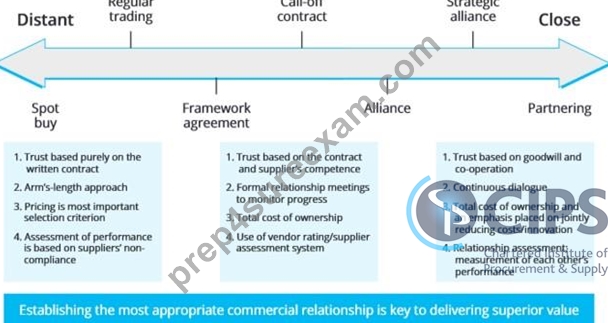
In the question, the contract is simple one-off (or spot buy), which means the relationship will likely to be more transactional. In such relationship, price is the most important criteria and buyer may adopt arm's-length approach.
NEW QUESTION # 151
XYZ Ltd is importing goods from overseas. They prefer to pay their supplier in their own currency. Which of the following is a true statement?
- A. XYZ has an advantage in negotiating discounts if their currency appreciates
- B. Supplier will receive less if XYZ's currency appreciates
- C. XYZ has to pay more if their currency depreciates
- D. XYZ is able to pay less if their currency depreciates
Answer: A
Explanation:
The effect of a change of relative exchange rates will be determined by which currency you pay your supplier in.
Table Description automatically generated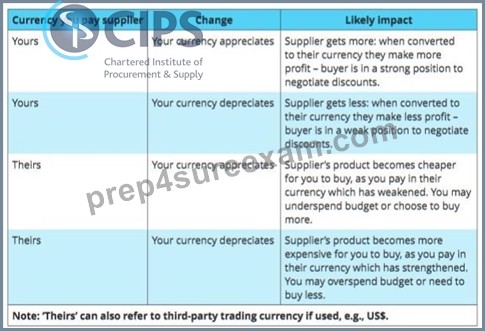
LO 2, AC 2.2
NEW QUESTION # 152
During a negotiation, the supplier requests for payment term shortened to 45 days from 60 days. Seeing that this proposal lies within the concession plan, the procurement manager asks for 5% discount in return. Is that right thing to do?
- A. Yes, the procurement manager should keep that 5% for himself because that amount is a fair compensation for his effort
- B. No, it is unethical to exploit the weakness of the other party
- C. No, procurement should insist the payment term remains 60 days
- D. Yes, since procurement manager has his own cost savings target to achieve and he should make use of supplier's financial status
Answer: D
Explanation:
When preparing for a negotiation, negotiator should establish a list of tradeables and a concession plan. Good negotiators never give anything away that has not already been planned as part of the bargaining mix in the concession planning stage.
In the above scenario, the procurement manager has planned his own concession, so he can trade with supplier. The answer should be "Yes, since procurement manager has his own cost savings target to achieve and he should make use of supplier's financial status" Table Description automatically generated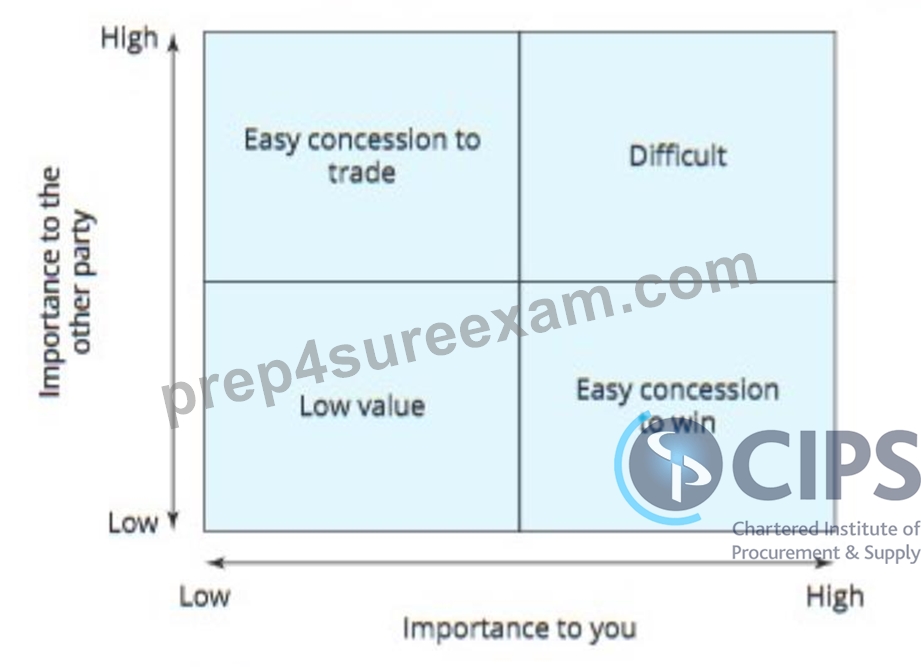
LO 2, AC 2.3
NEW QUESTION # 153
A procurement manager has decided to bring in a junior member of their team to a negotiation meeting.
Which of the following would be suitable roles for this junior member of the team?
- A. 3 and 4 (Observer and an unspecified fourth option - assumed error)
- B. 1 and 3 (Note taker and Observer)
- C. 2 and 3 (Expert and Observer)
- D. 1 and 2 (Note taker and Expert)
Answer: B
NEW QUESTION # 154
A procurement professional is sourcing low value items. He conducts market analysis and realise that these items can be provided by many suppliers and switching cost between suppliersis relatively low. He also assume that the relationship between buyer and supplier will be transactional rather than long-term. According to Thomas-Kilmann conflict model instrument, which of the following is the most appropriate style that the procurement professional should adopt when negotiating with these suppliers?
- A. Compromising
- B. Competing
- C. Avoiding
- D. Collaborating
Answer: B
Explanation:
According to Thomas-Kilmann conflict model instrument, there are 5 conflict management styles:
Graphical user interface, text, application, email Description automatically generated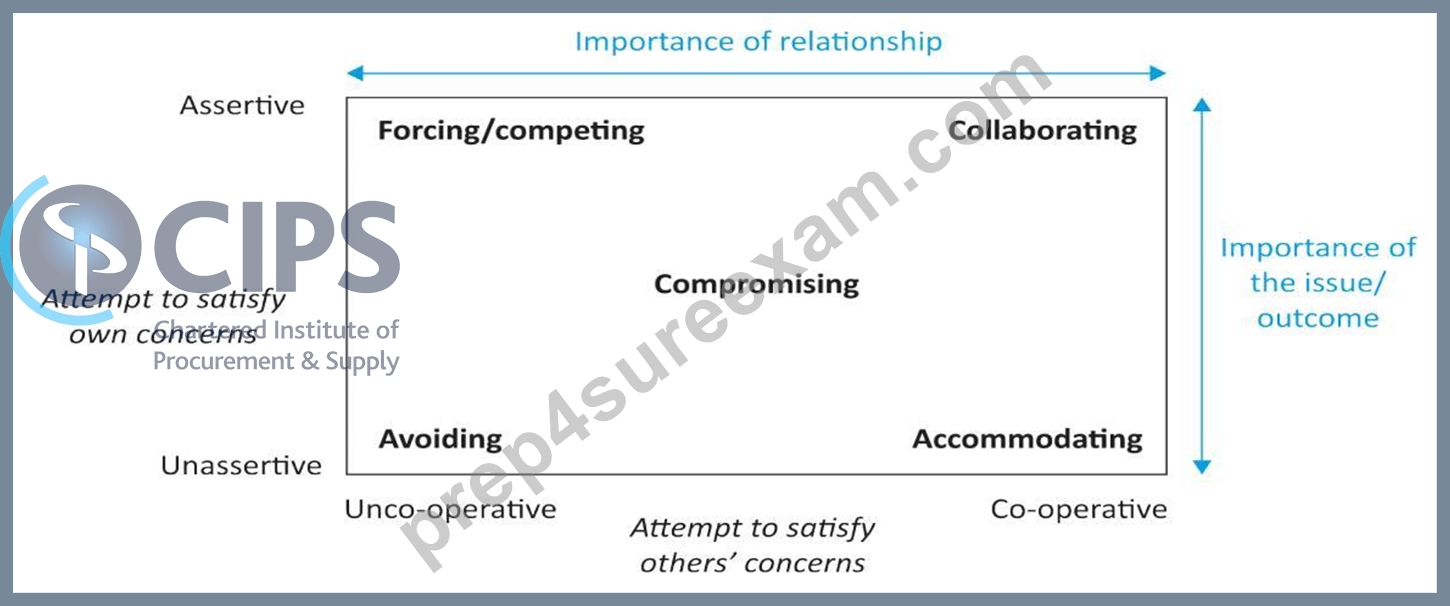
In this scenario, the buyer's bargaining power is stronger than suppliers', and the relationship is transactional.
Therefore, to get the most preferable outcome, the procurement professional can take an assertive approach, while he doesn't need to co-operate closely with these suppliers. Competing will be the most appropriate approach to negotiation in this scenario so that the buying organisation can get a better deal.
NEW QUESTION # 155
The purpose of ongoing supplier relationship management following a negotiation and contract award is that it:
- A. 3 and 4 (Enables the buyer to work with the supplier to resolve relationship problems and evaluate unnecessary concessions)
- B. 1 and 2 (Enables the buyer to monitor supplier performance and persuade the supplier to renegotiate better terms)
- C. 1 and 3 (Enables the buyer to monitor supplier performance and work with the supplier to resolve relationship problems)
- D. 2 and 3 (Enables the buyer to persuade the supplier to renegotiate better terms and work with the supplier to resolve relationship problems)
Answer: C
NEW QUESTION # 156
Which of the following is the most appropriate approach to investors or shareholders who have high level of influence but low interest in the running of business?
- A. Engage and keep them satisfied
- B. Manage them closely
- C. Engage and consult with them regularly
- D. Keep these people inform through general communication media
Answer: A
Explanation:
Investors or shareholders who have high level of influence but low interest belong to 'Keep satisfied' quadrant of Mendelow's Stakeholder Matrix.
You may read 2 versions from L4M1 and L4M5 here:
Table Description automatically generated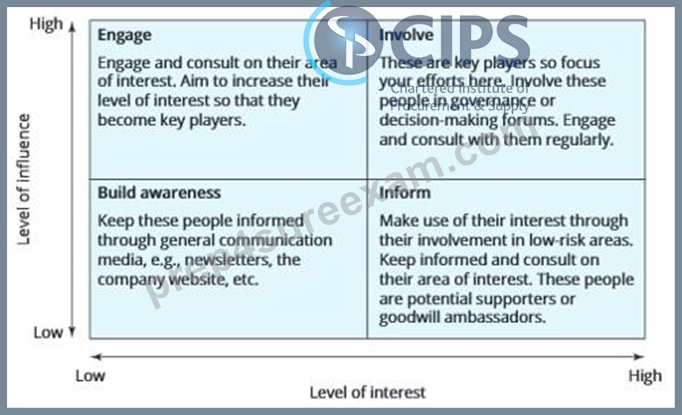
LO 1, AC 1.1
NEW QUESTION # 157
In preparation for holding negotiation meetings with existing suppliers, category manager Stephen would like to appraise the bargaining strength of his organisation. Which of the following are examples of buyer power?
Select TWO that apply:
- A. Ability to easily switch suppliers
- B. High barriers of entry exist for new suppliers
- C. Buyer is large in size relative to suppliers
- D. Suppliers are limited in number
- E. Collusion between competitor suppliers
Answer: A,C
Explanation:
Reference: CIPS L4M5 Study Guide, Section 2.3 - Market Factors and Analysis
NEW QUESTION # 158
......
Try Free and Start Using Realistic Verified L4M5 Dumps Instantly.: https://www.prep4sureexam.com/L4M5-dumps-torrent.html
L4M5 Actual Questions - Instant Download 387 Questions: https://drive.google.com/open?id=1KSb6KmZtM5oV9s4OgBgil_f0Gvio2yoj