

Free CIPS (L4M5) Certification Sample Questions with Online Practice Test
L4M5 Certification Study Guide Pass L4M5 Fast
NEW QUESTION 11
Which of the following is the true statement?
- A. Internal stakeholder support will be important for both negotiation and contract performance
- B. Commercial negotiation objectives should be driven by just the instincts of procurement
- C. All connected stakeholders have a low level of impact on procurement negotiations
- D. External stakeholders such as suppliers can largely influence an organisation's procurement negotiations
Answer: A
Explanation:
Internal stakeholder support will be important not just at the initial negotiation of the contract, but potentially throughout the life of the contract right through to exit.
As a general rule, connected stakeholders (with the exception of suppliers) have a low level of influence on procurement negotiations.
Suppliers are connected stakeholders who have contractual relationships with the organisation.
Commercial negotiation objective should be driven by thebusiness needs of the organisation, and not just the instinct of procurement.
NEW QUESTION 12
Sumitomo Rubber Industries (SRI) is a Japan-based tyre manufacturer. In order to increase production, SRI is sourcing rubber from Southeast Asian firms. Which of the following micro factors are most likely to shift the balance of power to supplier? Select TWO that apply
- A. Rubber from different suppliers is virtually similar
- B. There are no close substitutes for rubber
- C. Costs of changing suppliers are high
- D. SRI sets up its own rubber plantation
- E. SRI's purchase amount makes significant proportion of supplier revenue
Answer: B,C
Explanation:
There are many factors that can influence the balance of power in a negotiation. These factors are classified into 3 levels:
Macro level: STEEPLE framework: social, technological, economic, environment, political, legal and ethical Micro level: Porter's five forces:
Diagram Description automatically generated
One-to-one buyer-supplier dynamics.
The question asks about the micro factors that increases supplier's bargaining power. Among 5 answers, only 2 are likely to increase buyer's power:
There are no close substitutes for rubber: the buyer has to buy rubber, not any other material.
Costs of changing suppliers are high: buyer entails a large barrier if they want to switch supplier.
Other answers cannot be correct because:
SRI sets up its own rubber plantation: Buyer secures its own supply
SRI's purchase amount makes significant proportion of supplier revenue: Suppliers are reliant on buyer. If the buyer stops buying from them, they can face serious cash flow problems Rubber from different suppliers is virtually similar: undifferentiated product would shift the power balance towards buyer.
NEW QUESTION 13
Which of the following are most likely to be abilities of a person with high emotional intelligence? Select TWO that apply.
- A. Reasoning and problem solving
Abstract thinking - B. Controlling one's own emotions
- C. Complex idea comprehension
- D. Perceiving how others feel
Answer: B,D
Explanation:
Explanation
Emotional Quotient is the set of skills that enables us to make our way in a complex world - the personal, social and survival aspects of overall intelligence, the elusive common sense and sensitivity that areessential to effective daily functioning. It has to do with the ability to read the political and social environment, and landscape them; to intuitively grasp what others want and need; what strengths and weaknesses are; to remain unruffled by stress; andto be engaging. The kind of person others want to be around and follow.
EQ seeks to measure emotional intelligence and is centred on abilities such as the following:
- Identifying emotions
- Evaluating how others feel
- Controlling one's own emotions
- Perceiving how others feel
- Using emotions to facilitate social communication
- Relating to others
On the other hand, cognitive ability is defined as a general mental capability involving reasoning, problem solving, planning, abstract thinking, complex ideacomprehension, and learning from experience (Gottfredson,
1997).
LO 3, AC 3.3
NEW QUESTION 14
Which of the following are signs indicating that the trust between buyer and supplier has improved? Select TWO that apply.
- A. Less frequent communication on business requests
Duplication of effort - B. Cost overruns
- C. Transparent decision makingprocess
- D. Decreasing percentage of missed delivery overtime
Answer: C,D
Explanation:
Explanation
Signs of trust in business relationships
* Mutually agreed and managed objectives
* Sharing information
* Managing conflict through joint problem solving
* On time delivery of products and services
* High-performance teams that feel empowered to get the job done
* Supplier welcomes opportunity to innovate
* Both parties share ideas and insight
* Clear criteria for decision making
LO 1, AC 1.4
NEW QUESTION 15
Which of the following is considered a weakness of a 'dealer' style negotiator?
- A. Very precise
- B. May be too assertive
- C. Focuses on the facts and not the people
- D. May shift position quickly
Answer: D
Explanation:
Explanation
A useful and simple shorthand for preferred negotiation styles is summarised by four simple descriptor:
'warm', 'tough', 'logical' and 'dealer', which can beapplied to describe individuals' dominant preferred style in most circumstances.
Warm - a people person
Tough - a hard-nosed negotiator
Logic - a numbers person
Dealer - a trader who loves bargaining
Strengths, weaknesses of dealer style are described below:
Table Description automatically generated
LO 2, AC 2.4
NEW QUESTION 16
Which of the following are most likely to be sources of conflict that can emerge from the process of commercial negotiations? Select TWO that apply.
- A. Types of purchase
- B. Standard terms and conditions
- C. Line of the best fits
- D. Differences in culture
- E. Differences in conflict management style
Answer: D,E
Explanation:
There are multiple sources of divergent positions that can arise in situations where money is exchange for goods and services. There are 2 different types of sources. Those that arise from the content or subject matter of the negotiation (what is being negotiated) and those that arise from the process of negotiation (how it is being negotiated).
Sources of divergent positions - the process of negotiation:
Table Description automatically generated
Line of best fits is the line that goes approximately through the middle of the data points with an equal number of data points above and below it. Line of best fits is a method of calculating medium value instatistics.
Standard terms and conditions are basic terms and conditions of business governing transactions that do not have a definitive contract, usually designed to be included in form documents such as orders. While there may be conflicts regarding standard terms and conditions, they are about the content of negotiation, not the process.
Type of purchase: when buying organisation makes an decision to purchase an item, a buyer is faced with three possible scenarios. The item to be bought could be a straight re-buy, a modified re-buy or a new purchase. Decision on type of purchase is purely an internal decision.
NEW QUESTION 17
According to Fiona Dent and Mike Brent, which of the following are characteristics of Push approach? Select TWO that apply.
- A. Directive
- B. Seeking commitment
- C. Inspirational
- D. Collaborative
- E. Persuasion
Answer: A,E
Explanation:
According to the book 'Influencing: Skills and techniques for business success' by Fiona Dent and Mike Brent, there are two major influencing styles. Push tends to be directive. It tells, and is clear and resolute, but needs to be employed in situations where firmness is required because of difficulties that exist or weakness is evident.
Pull is more participatory and collaborative. It seeks to incorporate everyone's perspective. It can appear wishy-washy if not skilfully employed. That approach should be followed which is most likely to secure commitment and not mere compliance.
The two divisions can be further divided into four style categories: directive; persuasive reasoning; collaborative - team oriented, people oriented to inspire them with a vision. The directive style relies on your expertise and reputation being respected by others, and where there really does seem to be one answer. It is "I" driven whereas persuasive reasoning is more "we" and issue driven. Directive styles can make the user appear as "a bull in a china shop"; persuasive reasoning can be portrayed as tough guy.
Collaborative influencing takes the "we" element further and seeks to mobilise everyone's ideas in a journey of discovery. It may have the flavour of "I'm your best friend", which may not go down too well. Visioning style is concerned to stir people's emotions in support of achieving an objective. This last one has been used by demagogues to stir people's hearts and minds for evil purposes as well as good.
A useful table offers the benefits, problems, words and body language associated with each style along with advice on when to use and when to avoid each. Cases and exercises illustrate these styles.
Empathy comes in for extended treatment with the definition of "standing in the other's shoes". This does not necessarily happen just intuitively, and therefore before a specific influencing effort there should bean intense effort to think about the other person or persons and to sense what it might feel like to be them - their hopes, fears, concerns, what turns them on, what turns them off, where are they coming from.
NEW QUESTION 18
Where can we find the data on macroeconomics?
1. From trade journal
2. From supplier's marketing catalogue
3. From stock exchange market
4. From government's statistics
- A. 2 and 4 only
- B. 3 and 4 only
- C. 1 and 2 only
- D. 1 and 3 only
Answer: B
Explanation:
Explanation
Macroeconomic indicators are statistics or data readings that reflect the economic circumstances of a particular country, region or sector. They are used by analysts and governments to assess the current and future health of the economy and financial markets.
Macroeconomic indicators will vary in their meaning and the impact that they have on the economy, but broadly speaking there are two main types of indicator.
- Leading indicators, which forecast where an economy might be heading. They are often used by governments to implement policies because they represent the first phase of a new economic cycle. These include the yield curve, interest rates and share prices.
- Lagging indicators, which reflect an economy's historical performance and only change after a trend has been established. They are used to confirm a trend is underway. These include gross domestic product (GDP), inflation and employment figures.
There is also the category of coincident indicators, but these are generally grouped in with lagging indicators as they either happen at the same time or after an economic shift.
The best macroeconomic indicator to watch will heavily depend on your personal preferences, what positions you are taking and which country your portfolio is focused on. However, there are some very common indicators that most traders and investors will keep an eye on.
For simplicity's sake, we have split these out into leading and lagging indicators.
Top leading indicators:
1. The stock market
2. House prices
3. Bond yields
4. Production and manufacturing statistics
5. Retail sales
6. Interest rates
Top laggingindicators:
1. GDP growth rates
2. The Consumer Price Index (CPI) and inflation
3. Currency strength and stability
4. Labour market statistics
5. Commodity prices
A procurement professional may find stock market data from the security exchange, whilemost lagging indicators (such as GDP, CPI, unemployment rate, currency and inflation rate, etc) can be found from government statistics data.
NEW QUESTION 19
Which type of question should be used to receive affirmation on statement?
- A. Closed
- B. Leading
- C. Open
- D. Narrow
Answer: A
Explanation:
Different questioning styles can be used to elicit desired responses:
Text Description automatically generated
NEW QUESTION 20
According French and Raven's base model, which of the following are sources of personal power that can be used in commercial negotiation? Select THREE that apply.
- A. Legitimate power
- B. Purchasing spend power
- C. Trademark power
- D. Coercive power
- E. Competitive power
- F. Expert power
Answer: A,D,F
Explanation:
A useful model of personal power that has survived the test of time and provide a simple way to analyse negotiation in French and Raven's Power BaseModel, which describes six bases of power:
Diagram Description automatically generated
NEW QUESTION 21
Which of the following are most likely to help buyer become preferred customer in supplier's perspective?
Select TWO that apply.
- A. Compliance with agreed repair lead time
- B. Onerous supplier terms and conditions
- C. Reduction in delivery errors
- D. Shorter payment period
- E. Ensuring an increased number of repeat orders
Answer: D,E
Explanation:
Explanation
Becoming a preferred customer to supplier's perspective can increase the purchaser's leverage in negotiation.
Beside the size of buying organisation or its spend, the following may be sufficient to differentiate the buyer from other buying organisations:
- Simple procurement processes
- Simple contracting processes
- Clear and concise documentation
- Absence of onerous supplier terms and conditions (onerous supplier terms and conditions mean that obligations imposed on suppliers are greater than their gains)
- On-time payment: The reduction in hassle for both supplier and the buyer, if bills are paid on time, is significant. From the customer's perspective it could also be the opener to agreeing preferential payment terms. A supplier may weigh up that payment on time at 60 days is worth taking, over the current 30-day terms that slip to 90 days and beyond.
-Transparent processes
- Ethical behavior
LO 1, AC 1.3
NEW QUESTION 22
Which of the following is the first step in the development of negotiation strategies?
- A. Defining overarching objectives
- B. Recognising TOP'sneeds and wants
- C. Developing scenarios around possible options
- D. Determining your BATNA
Answer: A
Explanation:
Developing specific negotiation strategies in areas where risk or spend is high involves analysing a wide range of objectives and variables within the context of the organisation'sbusiness requirements. The first stage in any negotiation preparation is to define your overall objectives which may be related to a single variable such as price in the case of a standardised requirement, or many variables in the case of capital equipment. Your negotiating strategies and tactics will all be focused on achieving overall objectives.
NEW QUESTION 23
Rose is a senior buyer from a skiing equipment retailer. Rose is concerned about the current ski boot shortage and the number of invoicing problems from a key supplier. Shehas decided to have a video conference with Victor, CEO of the supplier. Initially, she intends to threaten Victor with contract termination unless he can improve the situation. However, she is a little wary of doing this as the switching costs are high. Eventually, she decides to seek solutions by encouraging the other party to offer their views and ideas. Rose also prepares some ideas to discuss with Victor. Which of the following is the persuasion method that Rose intends to use in the forthcoming conference?
- A. Directive (push)
- B. Persuasive reasoning (push)
- C. Collaborative (pull)
- D. Visionary (pull)
Answer: C
Explanation:
There are two major persuasion methods: 'push' and 'pull'.
Persuasion can be defined as encouraging someone to dosomething that you want them to do for you.
Persuasion is reasoning with someone so that they will believe or do something they might not otherwise do.
Persuasion can be considered as 'pushing' on TOP so that they can accept the change in attitude or behaviour as a result of your actions.
Influence is the ability to affect the manner of thinking of another. Influence can be considered as pulling on TOP so that you achieve the same result, but TOP feels they have changed their attitude or behaviour as a result of their reflection and thinking, and not your direct actions.
There are multiple variables to consider when choosing between 'push' and 'pull'. Professor Fiona Dent of Ashridge Business School proposes situations when each style might be most appropriate, breaking down push into 'directive' and 'reasoning' and 'pull' into 'collaborative' and 'visionary':
Table Description automatically generated
Text Description automatically generated
In the scenario, Rose intends to let both parties exchange their views and ideas so that solutions to current problems can be found. This is the typical characteristic of collaborative (pull) method.
NEW QUESTION 24
Which of the following are most likely to be the potential cultural differences that can make transactions with an international supplier more problematic that with local suppliers? Select TWO that apply.
- A. Payment mechanism
- B. The importance of timescales
- C. The use and interpretation of body language
- D. Currency exchange fluctuation
- E. Incoterms and logistics difficulties
Answer: B,C
Explanation:
Explanation
The question requires student to detect factors of cultural differences. Problems may occur on the international scene with such things as the importance of extending courtesy between cultures, the importance of timescales, the use of negotiating ploys, the sense of 'fair play', the use and interpretation of body language, the role of women in negotiations (or indeed, in business in general), the importance of status, the role of conflict, standards of dress and deportment and the readiness to ignore or uphold contract terms and conditions.
LO 3, AC 3.3
NEW QUESTION 25
If the price of a good is above the equilibrium price, which of the following will happen?
- A. There is a surplus (i.e. an excess supply) and the price will fall
- B. There is a surplus (i.e. an excess supply) and the price will rise
- C. There is a shortage (i.e. an excess demand) and the price will fall
- D. The quantity demanded is equal to the quantity supplied and the price remains unchanged
Answer: A
Explanation:
In microeconomics, equilibrium price is determined when the quantity demanded is equal to thequantity supplied at equilibrium price in a market, there will be no shortages and no surpluses. If we combine our supply and demand curves on one graph, the point at which they converge determines the equilibrium price. If the price is set above this price and you read across the graph you will see the supply excess demand and there will be a surplus. In order to reduce this surplus, the price will need to fall. The scenario is illustrated in the graph below:
Chart, line chart Description automatically generated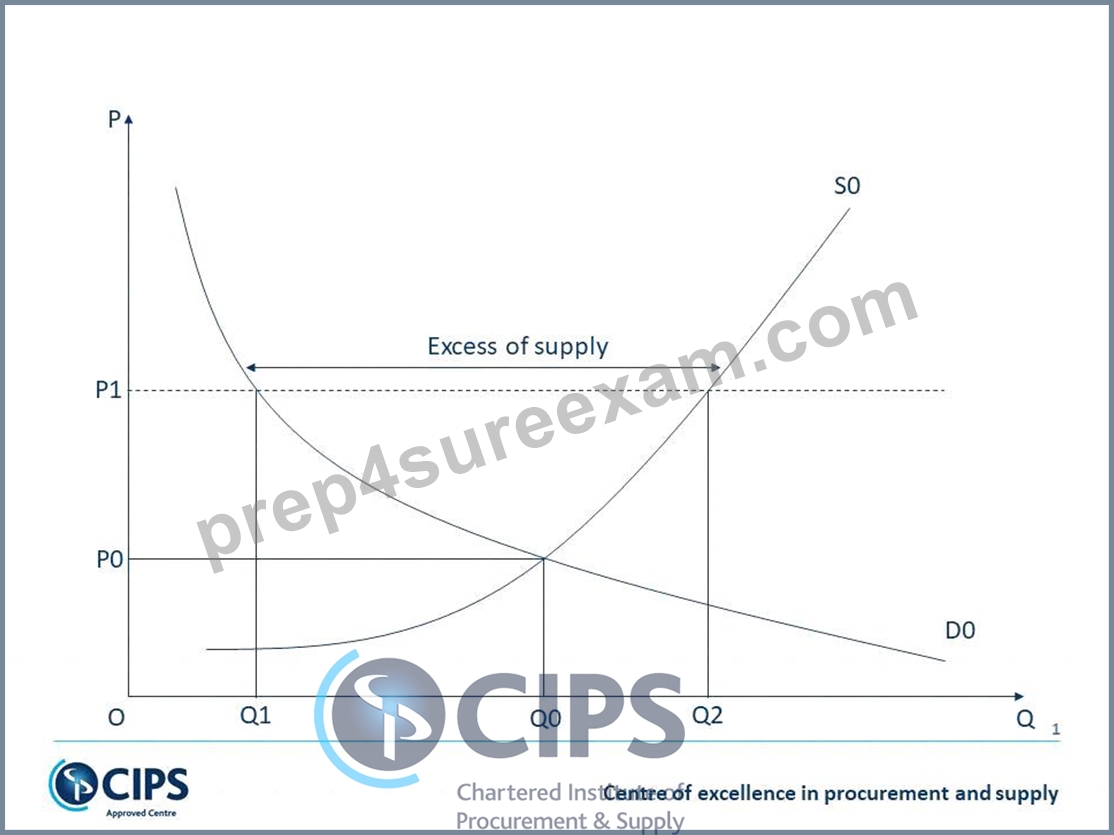
NEW QUESTION 26
Katie is preparing a negotiation with a strategic supplier. Through deep market analysis, she realises that her company and the supplier have equal bargaining power. Via regular communication, Katie knows that both parties are arguing on amount of liquidated damages and neither party shall concede all of their requirements but some are negotiable. Katie and her counterpart from supplying company still desire a long-term relationship and hope that the meeting between them will be a solution for current situation. Which of the following isthe most appropriate approach that Katie should adopt to achieve the above outcome?
- A. Compromising approach
- B. Avoiding approach
- C. Competing approach
- D. Accommodating approach
Answer: A
Explanation:
Explanation
Competing is assertive anduncooperative, a power-oriented mode. When competing, an individual pursues his or her own concerns at the other person's expense, using whatever power seems appropriate to win his or her position. Competing might mean standing up for your rights, defending a position you believe is correct, or simply trying to win. Competing will not allow long-term relationship to flourish.
Compromising is intermediate in both assertiveness and cooperativeness. When compromising, the objective is to find an expedient, mutually acceptable solution that partially satisfies both parties. Compromising falls on a middle ground between competing and accommodating, giving up more than competing but less than accommodating. Likewise, it addresses an issue more directly than avoiding but doesn't explore it in as much depth as collaborating. Compromising might mean splitting the difference, exchanging concessions, or seeking a quick middle-ground position. It is a valid approach when long-term relationships are at stake and it is important to find some common ground on which to base an agreement. Both sides get something but not everything. Therefore, this is the most appropriate for this scenario.
Avoiding is unassertive and uncooperative. When avoiding, an individual does not immediately pursue his or her own concerns or those of the other person. He or she does not address the conflict. Avoiding might take the form of diplomatically sidestepping an issue, postponing an issue until a better time, or simply withdrawing from a threatening situation. In the scenario, both parties want to take the opportunity, then avoiding is not an appropriate solution.
Accommodating is unassertive and cooperative-the opposite of competing. When accommodating, an individual neglects his or her own concerns to satisfy the concerns of the other person; there is an element of self-sacrifice in this mode. Accommodating might take the form of selfless generosity or charity, obeying another person's order when you would prefer not to, or yielding to another'spoint of view. In the scenario, neither party shall concede all of their requirements, it is unnecessary to adopt this approach.
LO 1, AC 1.1
NEW QUESTION 27
Should a buyer use closed questions in a negotiation?
- A. No, supplier will consider closed questions as provocation
- B. Yes, because closed questions help to reconfirm certain facts
- C. Yes, because they urge the supplier to provide more detailedExplanation::
- D. No, the buyer should maximise the use of open questions
Answer: B
Explanation:
Asking questions the right way is both an art and a science. Ask the question the wrong way, and the other negotiator might act like a turtle, becoming defensive and withdrawing into their shell. Ask the question the right way, and the other negotiator might "spill the beans.".
Closed Questions: How and when to use them?
Closed questions are those thatrequire a short and focused answer, and are especially helpful in the beginning stages of the negotiation to encourage interaction. They can be used to clarify a point, or to reconfirm certain facts. For example, you can use a closed question to confirm the amount of units the company can produce in a week, or to clarify that what they are really saying is that they don't feel comfortable outsourcing their accounts to India. Most closed questions only require a simple "yes" or "no" response, so there reallyisn't much room for misinterpretation - great for finding out where both you and they stand.
NEW QUESTION 28
A procurement professional is sourcing low value items. He conducts market analysis and realise that these items can be provided by many suppliers and switching cost between suppliersis relatively low. He also assume that the relationship between buyer and supplier will be transactional rather than long-term. According to Thomas-Kilmann conflict model instrument, which of the following is the most appropriate style that the procurement professional should adopt when negotiating with these suppliers?
- A. Collaborating
- B. Competing
- C. Avoiding
- D. Compromising
Answer: B
Explanation:
According to Thomas-Kilmann conflict model instrument, there are 5 conflict management styles:
Graphical user interface, text, application, email Description automatically generated
In this scenario, the buyer's bargaining power is stronger than suppliers', and the relationship is transactional.
Therefore, to get the most preferable outcome, the procurement professional can take an assertive approach, while he doesn't need to co-operate closely with these suppliers. Competing will be the most appropriate approach to negotiation in this scenario so that the buying organisation can get a better deal.
NEW QUESTION 29
Representatives from South African Department of Health is negotiating the price of hospital drugs with US pharmaceutical companies. Which of the following are most likely to be macro factors that influence the outcomes of the negotiation? Select TWO that apply.
- A. Digitalisation of medicine
- B. Forward integration
- C. Order quantity
- D. Regulations on health and safety
Switching costs of buyer
Answer: A,D
Explanation:
Explanation
All one-to-one commercial negotiations between a specific purchaser and a specific supplier take place within an industrial market and a larger business environment characterised by multiple forceswhich both parties typically have little control over. STEEPLE framework highlights the 6 main external influences on a business:
Table Description automatically generated
Particularly, pharmaceutical industry is a heavily regulated sector, therefore, legal and regulatory matters in theindustry is highly important. Otherwise, technological trends also permeate into pharmaceutical companies, technologies like digitalisation may transform the balance of power in such negotiation.
LO 1, AC 1.3
NEW QUESTION 30
It may be more difficult to buy on a credit from supplier who locates in a country with a hyperinflation? Is this assumption true?
- A. Yes, because thesupplier's currency will lose its value overtime
- B. No, because supplier's bank will take risks from currency fluctuation
- C. No, because the higher the inflation rate, the stronger the supplier's currency
- D. Yes, because buyer has more advantage if they make payment in their own currency
Answer: A
Explanation:
If theinflation rate is running high, then obtaining credit as a buyer is normally more difficult or expensive as money in the future will be worth less than money today.
NEW QUESTION 31
Which of the following are most likely to be fixed costs of an airline? Select TWO that apply.
- A. Advertising and promotion
- B. Purchase of aircraft
- C. Flightcrew training
- D. Catering services
- E. Fuel
Answer: B,C
Explanation:
Explanation
Fixed costs (FC) are costs that do not vary with volume. To an airline once aircraft are purchased, flight crews trained and departures scheduled, costs are disproportionately fixed.
Variable costs (VC) arethose which vary with the amount produced. Fuel, catering services and marketing are examples of variable.
LO 2, AC 2.1
NEW QUESTION 32
Which of the following are most likely to beindirect costs of a garment manufacturer? Select THREE that apply.
- A. Zips pads
- B. Packaging material
- C. Utilities
- D. Textile
- E. Depreciation of machinery
- F. Maintenance materials
Answer: C,E,F
Explanation:
Indirect costs are those cost that are not directly attributable to production. Examples of indirect costs including the following:
Indirect labour: This covers every person in the factory who does not directly perform a production operation such as managers, supervisors, engineers, store personnel,clerks, maintenance staff, porters, canteen staff, security and cleaners etc.
Expenses: Included in this element is every fixed and variable expenses incurred in operating the factory, such as rent, rates, utilities, insurance, depreciation, maintenance, air conditioning and the various types of energy generation required by a clothing factory.
Indirect materials: Also known as consumables, this element contains all the materials not directly connected to the makeup of a garment. Some of the typical items involved are office materials, spare parts, marker paper, maintenance materials, chalk & pins.
Direct costs are those costs of a product/service directly attributable/traceable to its production. Examples of direct costs including the following:
Direct Materials: Direct materials are all the materials and trimmings which go into the construction and finish of the garment. Typically, these materials would include cloth, lining, fusible, zips pads, tapes, labels, tickets, hangers and packaging materials.
Direct Labour: This cover the cost of all the labor directly involved in producing the garment and could include cutting, fusing, regular sewing, special machine operations, pressing, finishing, inspection and packing. Labor of all types and grade has a directoverhead which include holiday pay, sick pay, fringe benefits etc and the statutory payments made by the employer for each employee. This is usually expressed as a percentage of salary and when this percentage is added to the employee's wage, it becomes the basis for calculating direct labor costs.
NEW QUESTION 33
Which of the following is most likely a consequence of falling interest rate?
- A. Decrease investment
- B. Decreaseconsumption
- C. Increase savings
- D. Increase aggregate demand
Answer: D
Explanation:
If interest rate are too low and credit is too, cheap rates can fund a spending boom with consumers and businesses buying (investment) more than they can afford to pay back.
NEW QUESTION 34
......
Get Perfect Results with Premium L4M5 Dumps Updated 165 Questions: https://www.prep4sureexam.com/L4M5-dumps-torrent.html
L4M5 Dumps PDF 2022 Program Your Preparation EXAM SUCCESS: https://drive.google.com/open?id=1KSb6KmZtM5oV9s4OgBgil_f0Gvio2yoj